Buy or rent in Zurich? The 2026 numbers for one flat
The numbers first
For most people moving to the city of Zurich in 2026, renting costs less than buying. A typical 4-room flat sells for about 53 years of its rent. Buying it takes roughly CHF 344,000 in cash and, by the usual bank test, an income near CHF 300,000. And owning only comes out cheaper with a mortgage below about 1.3%.
That's the short version, and it has two real exceptions: you plan to stay for a long time and have the cash, or you have to move anyway and are comparing a purchase with today's asking rents rather than with your current lease. The rest of this guide works through one flat with the city's own figures, so you can swap in yours.
What flats sell for, and what they rent for
The cleanest way to compare the two markets is the price-to-rent ratio: the price of a flat divided by one year of its rent. In the city of Zurich it is extreme. Statistik Stadt Zürich recorded 224 sales of 4-room condominium flats in 2025, at a median price of CHF 1,995,000, or CHF 17,193 per square metre of living space. Across all sizes, the median flat sold for CHF 1,681,598 (CHF 17,646 per m², 720 sales).
The city's rent survey of April 2026 puts a private 4-room flat let in the last two years at a median net rent of CHF 27.26 per m² a month, or CHF 2,690 for the whole flat. Net rent leaves out service charges such as heating and hot water; with them, the median is CHF 29.72 per m².
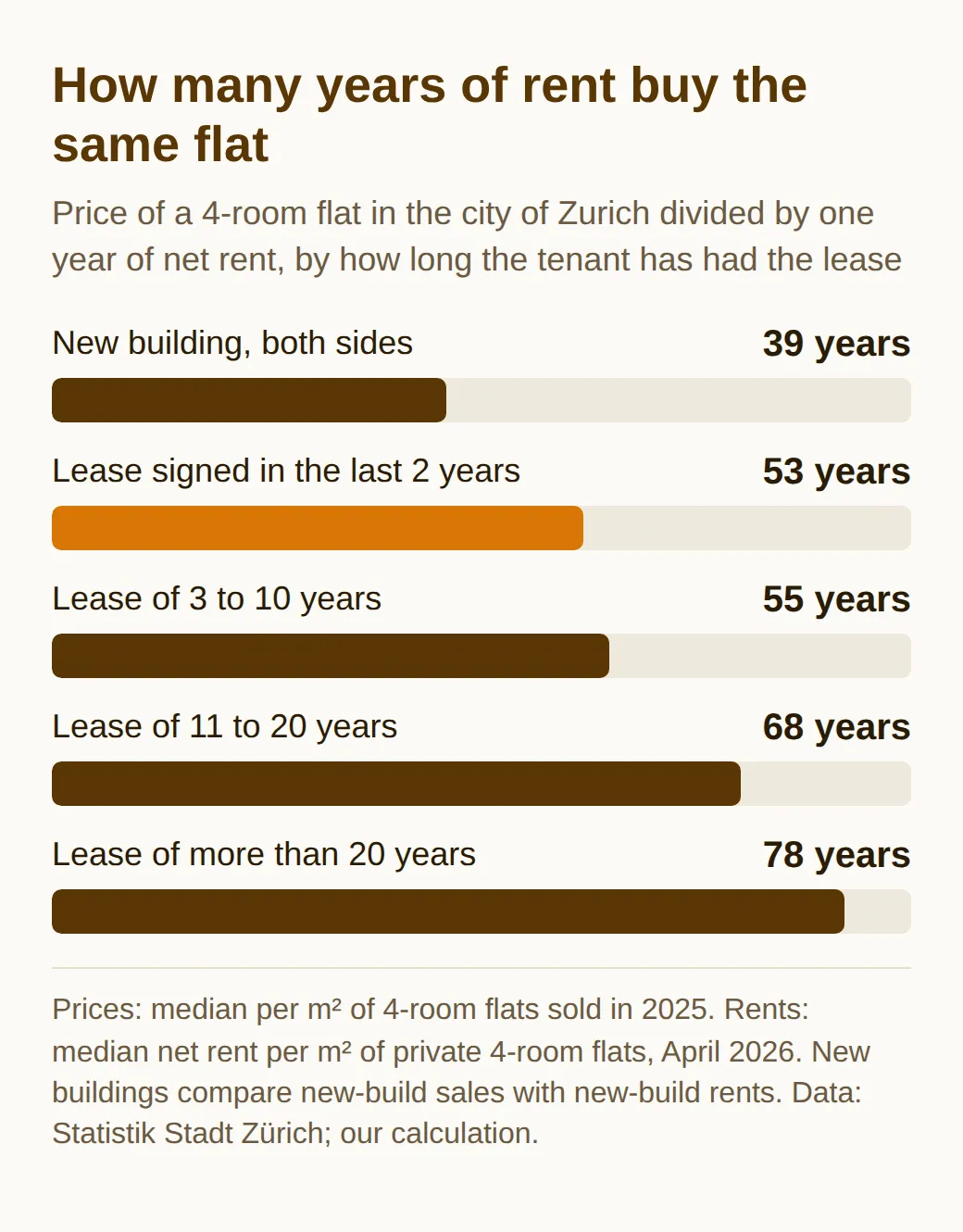
So the flat costs what a new tenant pays in 53 years of rent. Turned around, the rent earns the owner about 1.9% of the price a year before any costs, and that's less than the 2.03% a 10-year fixed mortgage cost on average at the end of August 2026 (more on rates below). Tenants who've stayed put are even further from buying: with a lease older than 20 years, the same flat is worth 78 years of rent. New buildings look kinder at 39 years, mostly because new-build rents are so high.
Prices have mostly gone one way. The city's median price per m² rose from CHF 7,738 in 2009 to CHF 17,646 in 2025, about 2.3 times, or roughly 5% a year, with only a few small dips along the way. The Zürcher Kantonalbank (ZKB) reports that, adjusted for quality, homes in the canton cost about 2.5 times what they did 20 years ago, and 2.8 times in the city and around the lake. Much of that rise came while interest rates fell to zero and below, which is worth keeping in mind before you count on it continuing. Before any of that matters, though, a bank has to agree to lend.
The two rules that decide if you can buy at all
Two rules shut most first-time buyers out long before the question of cost: how much of the price you must bring, and how much income the bank wants to see.
The first comes from the Swiss Bankers Association's minimum requirements for mortgages, recognised by the financial regulator FINMA. At least 10% of the property's lending value (the lower of the price and the bank's own valuation) must be your own money and must not come from your pension fund. The mortgage must then be paid down to two thirds of that value within 15 years. PostFinance asks buyers for at least 20% of the price, and ZKB's own comparisons assume a loan of 80%. The second 10% may come from your occupational pension: the federal social insurance office's rules allow a withdrawal of at least CHF 20,000, once every five years, only for a home you live in, and you pay it back when you sell.
The second rule is affordability (in German, Tragbarkeit). The bankers' guidelines leave the details to each bank, which sets its own long-term test rate and its own limit on costs against income. The common version, as PostFinance describes it, is strict: your housing costs, counted as 5% interest on the mortgage, plus amortisation, plus 1% of the property's value for upkeep and running costs, must not be more than a third of your gross income. The 5% is a long-term test rate, far above today's rates, so the loan stays affordable if rates rise.
Here is that test on a 100 m², 4-room flat at the city's median price of CHF 17,193 per m²:
- Price: CHF 1,719,300, of which CHF 343,860 in cash and a mortgage of CHF 1,375,440.
- Test interest at 5%: CHF 68,772 a year.
- Amortisation down to two thirds in 15 years: CHF 15,283 a year.
- Upkeep and running costs at 1%: CHF 17,193 a year.
- Total CHF 101,248 a year, so a gross household income of about CHF 303,700.
Renting the same flat at CHF 2,972 a month with charges would pass the same one-third rule on an income of about CHF 107,000. The bank wants nearly three times as much from a buyer as a landlord would want from a tenant, for the same rooms. That gap is a big part of why most Zurich households rent: in the canton, 71% of households rent, and the canton calls the share in the city very high. But say you pass the test. Is buying then the cheaper way to live?
One 100 m² flat, rented or bought
What owning really costs each year depends mostly on your mortgage rate, and with today's rates it lands on both sides of the rent. To compare like with like, count only money that's gone: interest, upkeep, and the interest your cash would have earned in the bank. Amortisation isn't a cost here, because it moves your money into the flat, where you get it back when you sell.
For rates, the Swiss National Bank collects the rates banks publish for new business. At the end of August 2026 they averaged 2.03% for a 10-year fixed mortgage, 1.76% for 5 years and 1.10% for a mortgage tied to the SARON money-market rate, which moves with the central bank's policy rate (the SNB left it at 0% in September 2026). Savings accounts paid 0.07% on average.
| Per year | Rent | Buy, 10-year fixed | Buy, SARON |
|---|---|---|---|
| Rent with charges | CHF 35,664 | ||
| Mortgage interest | CHF 27,921 | CHF 15,130 | |
| Upkeep and running costs, 1% | CHF 17,193 | CHF 17,193 | |
| Lost interest on CHF 343,860 | CHF 241 | CHF 241 | |
| Total | CHF 35,664 | CHF 45,355 | CHF 32,564 |
With a 10-year fixed rate, owning costs about CHF 9,700 a year more than renting, or roughly CHF 810 a month. With a SARON mortgage it costs about CHF 3,100 less, as long as the policy rate stays at zero. The line between the two is a mortgage rate of 1.33%.
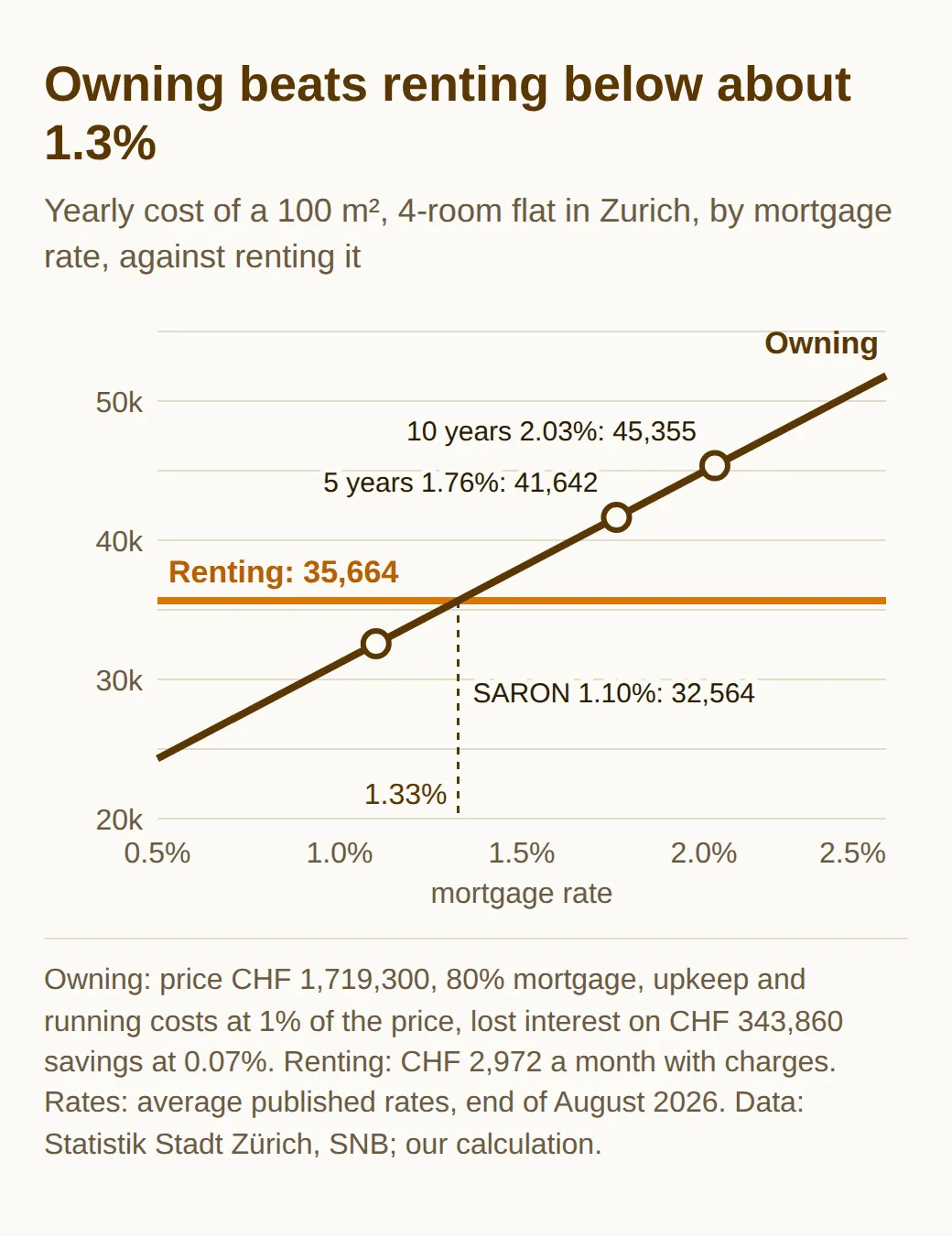
Three things this sum leaves out push in different directions. The 1% for upkeep and running costs is the banks' rule of thumb, not a bill; a well-kept flat in a newer building may cost less in some years and much more when the roof or the heating is due. The lost interest is tiny only because savings pay almost nothing; if you'd otherwise invest that CHF 343,860 in shares, the true cost of tying it up in a flat is much higher, though not guaranteed. And the sum ignores price changes, which is the bet every buyer makes.
You can put a number on that bet. With a 10-year fixed mortgage, owning costs about 0.56% of the price a year more than renting. So the flat has to gain at least that much in value each year just to break even, before fees and taxes. Over the last 16 years Zurich prices did far better than that, while rates fell. Over the next 16, nobody knows. Fees are small next to the price. Zurich's notary offices charge 1 per mille of the price for the contract, plus VAT, and the land registry takes another 1 per mille: about CHF 3,600 for this flat, plus the cost of registering the mortgage. The canton has charged no transfer tax since 2005. Taxes are the bigger moving part, and they change on a fixed date.
The imputed rent tax ends on 1 January 2029
Until the end of 2028, owners in Switzerland pay income tax on an imputed rent, the Eigenmietwert: a notional rent for living in their own home. In return they can deduct mortgage interest and upkeep. From 1 January 2029, for a home you live in, all three go, apart from two narrow exceptions. The Federal Council set that date on 1 April 2026, after voters approved the change in September 2025 with 57.7%.
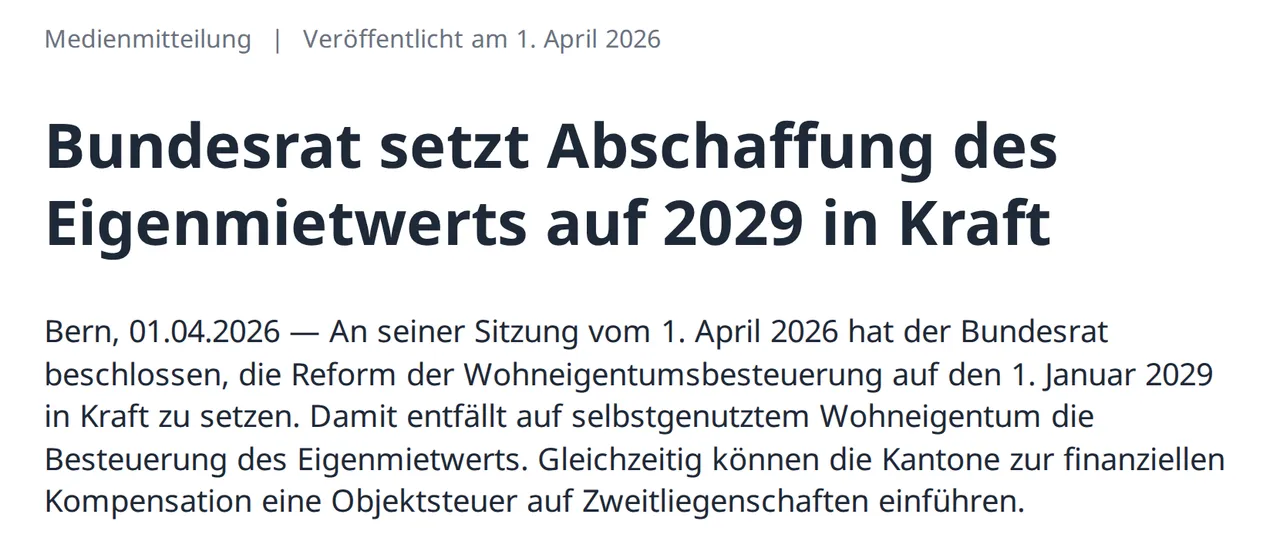
The press release lists what changes. No more tax on imputed rent for owner-occupied homes, and no more deduction for upkeep on them, at federal, cantonal or municipal level. Mortgage interest stays deductible only in proportion to the rented-out property you own against all your assets, so for someone with just one home it drops to zero. First-time buyers get a limited deduction instead.
That deduction is set in the law itself. If you buy your first home in Switzerland and live in it permanently, you can deduct interest of up to CHF 10,000 as a married couple, or CHF 5,000 otherwise, in the first tax year after buying. The cap falls by a tenth of that amount each year and ends after ten years. People who bought their first home up to ten years before 2029 keep the years they have left.
Whether that helps or hurts you depends on your debt. Take our flat. ZKB says Zurich's imputed rents average around 60 to 70% of the market rent, which here means about CHF 19,600 to 22,900 a year. Zurich lets you deduct a flat 20% of that for upkeep instead of your actual costs, which leaves CHF 15,700 to 18,300 of extra income. Against CHF 27,921 of interest on a 10-year mortgage, today's system gives this buyer a net deduction of roughly CHF 9,600 to 12,200 a year. From 2029 most of it disappears: a married couple buying now keeps only the first-buyer cap, which starts at CHF 10,000, drops by CHF 1,000 a year and is already lower by 2029. Multiply the lost deduction by your marginal tax rate to see what it costs you.
So the reform favours owners with little or no mortgage and costs heavily borrowed new buyers, the very people our example describes. The canton of Zurich has decided not to raise imputed rents on homes built up to 2025 before the system ends. New builds from 2026 fall under its new, higher valuation rules, with a flat 10% deduction to soften them.
When buying is the better deal
Buying makes the most sense when you'd have to move anyway, and ZKB's research on renting against owning explains why. Its July 2026 study of the canton found that tenants who've lived in the same flat for years usually do best by staying, thanks to what it calls the Verweilbonus, the bonus for staying. Their rent has fallen behind the market. But when a household has to move, because a child arrives, the landlord gives notice or a job moves, it faces today's asking rents, and those were often above the cost of owning. For an average 4-room flat in the canton, financed at 80% with a 10-year fixed mortgage, the bank found asking rents above owners' costs, and existing rents below them.
The city's rent survey shows the size of that bonus. A private 4-room flat let in the last two years rents for a median CHF 27.26 per m², one held for more than 20 years for CHF 18.26. That's a third less for the same kind of flat. If you're already in one of those older leases, buying is very unlikely to beat it. If you're arriving in Zurich and signing a new lease either way, the comparison is closer: in our example, owning beat a new lease with a SARON mortgage and lost with a 10-year fixed one.
Time decides the rest. A purchase only pays off over years: you need time for the flat's value to cover the extra cost, the fees and, if prices slip, the loss. A pension withdrawal has to be repaid when you sell. For a posting of two or three years, renting is almost always the better choice. For a family planning to stay ten years or more, owning also brings things money can't easily price: nobody can give you notice, and you can change the kitchen.
Renting well while you decide
If the numbers say rent, your aim is a good lease you can keep, because that's how you collect the bonus for staying. Our guide to finding an apartment in Zurich covers the search and the application file, and the districts guide compares rents across the 12 districts. Once you have a lease, knowing your rights as a tenant protects it: notice, rent increases and the reference rate all affect how long the bonus lasts.
If you're leaning towards buying, do three things before you look at listings. Ask a bank for an affordability calculation with your real income, so you know your price ceiling. Get your pension fund statement to see what you could withdraw or pledge. And compare a purchase with the rent of a flat you would actually move into, not with your current rent, because that's the comparison the numbers above turn on.
Common questions
Can a foreigner buy a flat in Zurich?
Yes, in most cases if you live here. The canton says EU and EFTA citizens living in Switzerland and holders of a C permit can buy like Swiss citizens, and citizens of other countries can buy without authorisation if they live in the home themselves at their legal place of residence. People living abroad need approval from the district council.
Can I use my pillar 3a savings as equity?
Yes. The bankers' association rules count a pledge of pillar 3a savings, securities or the surrender value of a life policy as your own funds. Pillar 3a is not part of your occupational pension, so it can count towards the 10% of the lending value that must not come from your pension fund.
What happens to my pension money if I sell?
You have to pay back what you took from your pension fund when you sell. The federal social insurance office says you can avoid this if you put the money into a new home of your own within two years. The restriction on selling is also noted in the land register.
Do Zurich rents fall when interest rates fall?
Existing rents can. They are tied to the federal reference rate, which has stood at 1.25% since September 2025, and ZKB found that 15% of renting households in the canton got a cut in the second quarter of 2026. Asking rents for new leases follow the market instead, and ZKB expects them to keep rising.
More from the blog
All posts
Internet provider for your Zurich apartment: 2026 checklist
Before you choose an internet provider for a Zurich apartment: check fibre and cable at the address, find the socket ID, know the notice rules, order in time.

Quiet apartment in Zurich? Check the noise maps first
Is that Zurich flat quiet? Read the city's noise map spot by spot, the airport's runway hours and the legal limits, and know your rights if it gets louder.
Airbnb rules in Zurich 2026: can a tenant let their flat?
Airbnb rules in Zurich for tenants: landlord consent, how often and at what price, the city's 2026 zoning rule, guest registration and the City Tax.