Airbnb rules in Zurich 2026: can a tenant let their flat?

Before you list
Yes, but only with your landlord's consent, and only now and then. A Zurich tenant may let their flat to guests while away, at a price close to the rent. A landlord can refuse regular weekend letting, and a tenant who ran two flats as a business without asking was evicted. The city's new zoning rule targets flats nobody lives in.
That's the short version. The rest of this guide shows where Zurich courts have drawn the lines, with real cases and real francs, and what you have to sort out with the police and the tourist office before your first guest arrives.
Do you need your landlord's consent?
Yes, every time. Swiss law lets a tenant sublet all or part of a home "with the landlord's consent" (art. 262 of the Code of Obligations), and the Zurich courts treat a booking on Airbnb or a similar site as a sublet. The same article limits the landlord, though. Consent may only be refused for three reasons: you won't say on what terms you're letting, those terms are abusive compared with your own lease, or the landlord suffers a serious disadvantage.
That sounds generous until you see how courts apply it to holiday letting. In April 2025 Winterthur's rental court heard a tenant who wanted general consent to let his 2.5-room flat on Airbnb for 6 to 9 days a month over two years. The court turned him down on two points. First, the law gives no right to blanket consent for future guests nobody has named yet. A landlord may check each sublet on its own, and the court thought two to four weeks for that check was reasonable, adding that tenants letting for short stays simply have to live with the delay. Second, the sublet rules exist for tenants who are away for a while, for work abroad for example, not to let a flat be listed on booking sites regularly.
Your lease may add form rules on top. The leases in two of the cases in this guide required written consent and the guest's details in advance, and the courts accept rules like that, as long as the rules don't amount to a hidden ban on subletting. Read the sublet clause of your contract before you write to your landlord.
The rule itself has survived an attempt to tighten it. Parliament passed a stricter version in 2023, with written consent, set details for every request and a right to refuse sublets longer than two years (the federal housing office's comparison). Voters rejected it on 24 November 2024, with 51.6% voting no nationwide and 69.6% in the city of Zurich. So the current text still applies, and so does the question every Zurich case turns on: how often.
How often is too often?
There's no number of nights in the law. What exists are court rulings, and two cases from the canton of Zurich mark out the range from fine to fatal.
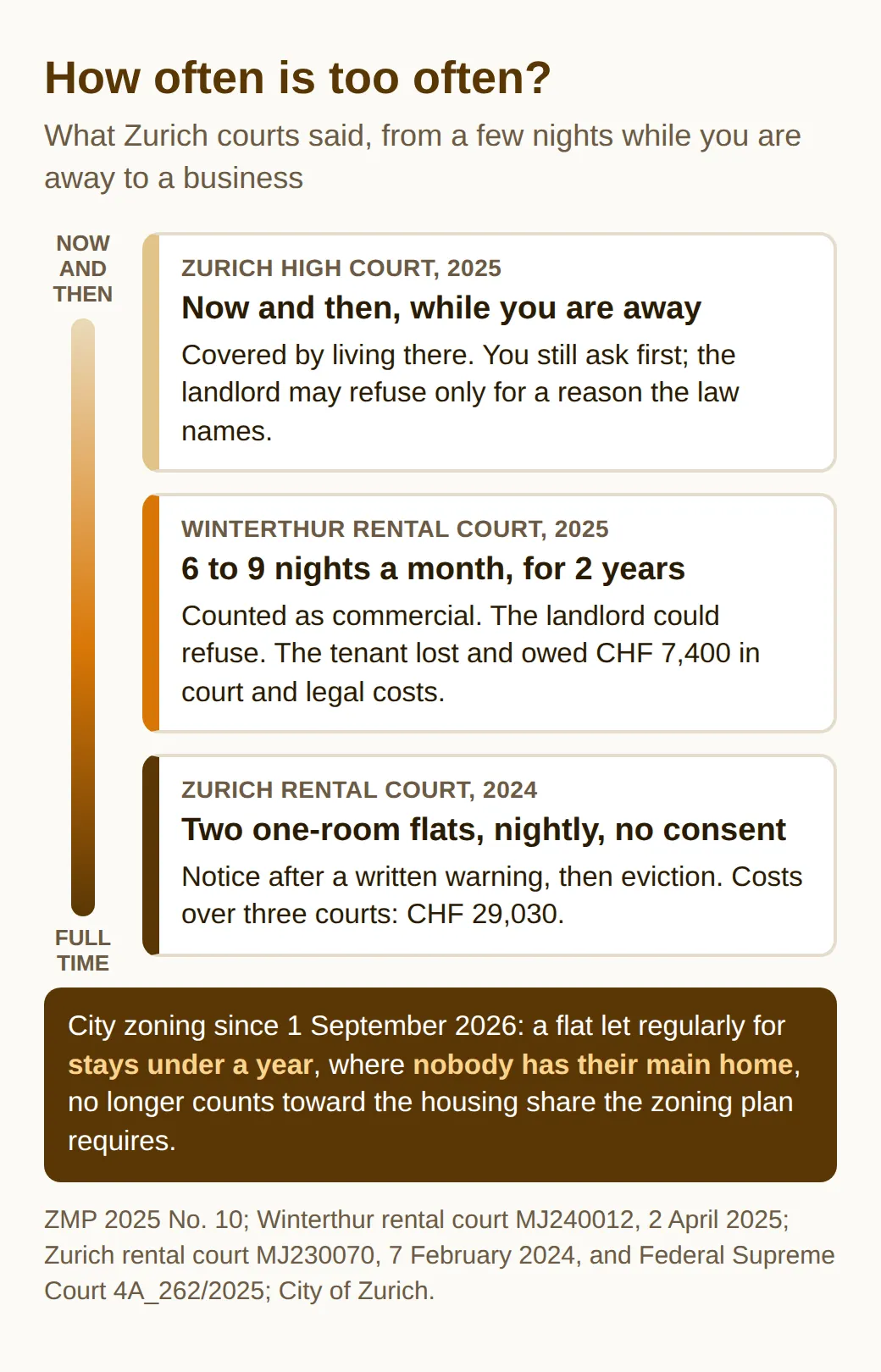
Now and then, while you're away
Letting your home occasionally through a booking site is covered by the purpose of your lease, which is living there. Zurich's high court said so in a 2025 ruling, the same one that settled the two-flat case further down, and that's the space you have. You still need consent, but a landlord who refuses a few nights while you're on holiday has to point to one of the three legal reasons.
Most weekends
The Winterthur tenant asked for 6 to 9 nights a month, roughly a third of the year. The court held that this was commercial, because the point was a regular income to cover the rent, even though he had another main job. It added two disadvantages for the landlord: more wear from a constant change of guests, and noise. A neighbouring family had complained, and the court said a landlord in a quiet residential area should expect exactly that. It also noted that the building stood in a purely residential zone, where a commercial guest business would probably not get a building permit at all. The tenant lost, paid the court fee of CHF 3,300 and owed the landlord CHF 4,100 towards legal costs.
A business
The far end is a tenant who rented two one-room flats in Zurich on fixed-term leases in 2023, at CHF 1,585 and 1,635 a month, and listed both on Booking.com and Airbnb at about CHF 215 a night, with several guests at a time and no written consent. The landlord's property manager asked him to take the listings down and sent a written warning. He refused, insisting he needed nobody's permission. The landlord gave notice on both flats for 31 August 2023.
He lost at every level. The Zurich rental court upheld the notices and ordered him out in February 2024; the high court dismissed his appeal in April 2025; and the Federal Supreme Court would not hear his appeal against the notices in August 2025, because he had already moved out. Court fees and the landlord's legal costs across the three courts came to CHF 29,030, or the rent on both flats for about nine months.
Frequency is only half of it. The other half is what you charge.
How much may you charge guests?
Roughly what the flat costs you, plus a fair amount for what you add. A landlord may refuse consent if your terms are abusive compared with your own lease, and the Zurich courts explain what that means: you may not make a profit that your own services don't justify. Furniture, cleaning and the work of managing bookings can justify a surcharge. According to the legal commentary the Zurich rental court relied on in 2017, a small margin of about 3% or CHF 100 a month needs no justification at all.
That 2017 case gives the clearest figures for a nightly let. A tenant rented a 4.5-room flat for CHF 2,914.40 a month, gross, and listed it on Airbnb at CHF 220 a night plus a cleaning fee, without asking his landlord. The court worked it out per day.
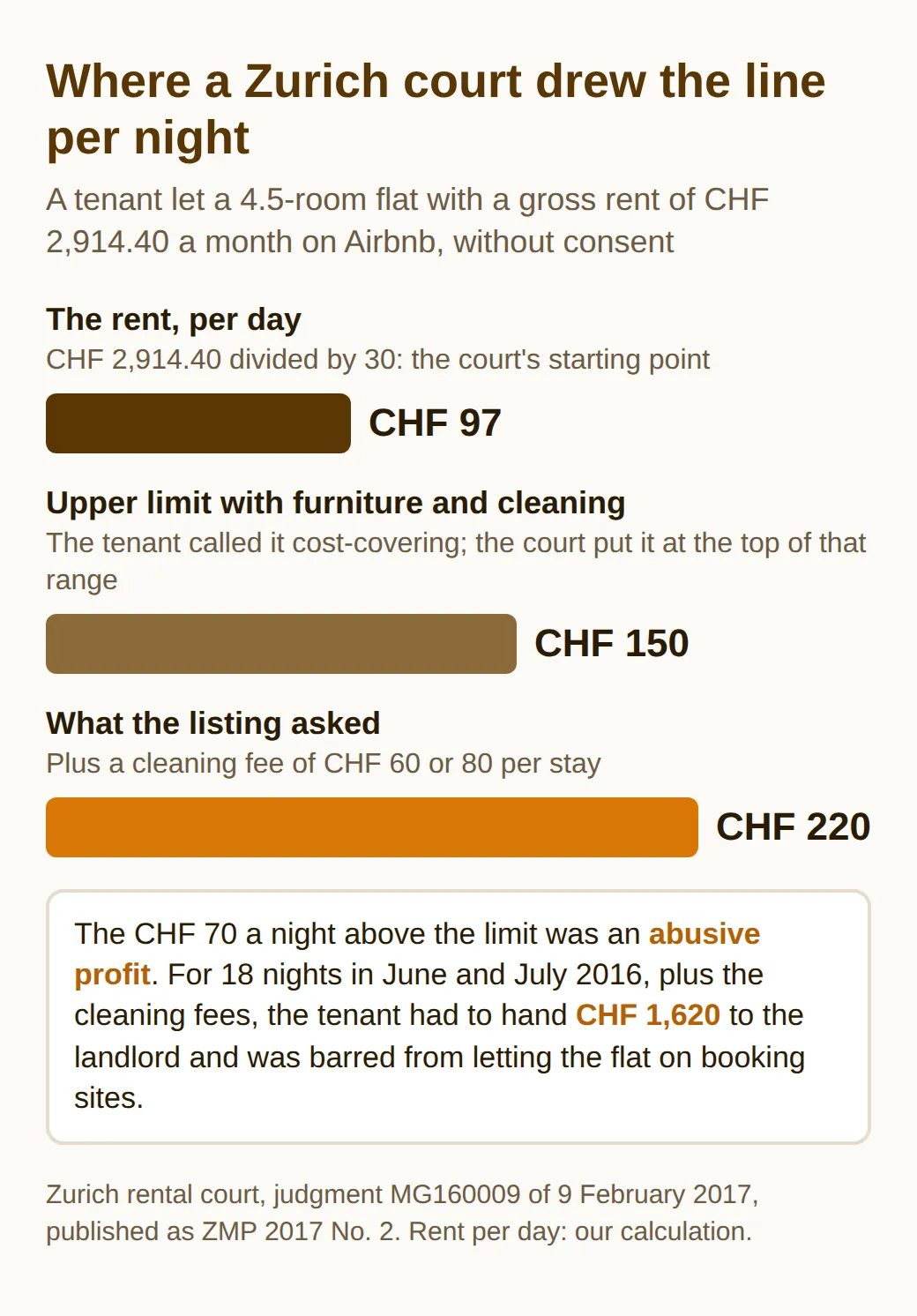
The monthly rent divided by 30 came to about CHF 100 a day. With furniture and cleaning, the court put even CHF 150 at the top of what was cost-covering, especially for letting that is more than occasional. CHF 220 was abusive, and that on its own was a ground to bar the tenant from letting the flat on booking sites. He also had to pay the landlord the profit. For the 18 nights the court could prove in June and July 2016, that was CHF 1,620. The legal basis is a rule on managing someone else's business (art. 423): if you profit from letting the landlord's property without consent, the landlord can claim that profit.
Do the sum for your own flat before you set a price. Take your gross monthly rent, divide by 30, and add what a night really costs you in cleaning, linen and wear. If your nightly price is far above that, expect a refusal, or a bill later. And if you've already listed without asking, the next section is the one to read.
What happens if you list without asking?
Usually a warning letter first, and notice if you carry on. A tenant who keeps breaking the duty of care or consideration for neighbours despite a written warning can be given notice of at least 30 days to the end of a month (art. 257f). In the Zurich two-flat case, that's exactly what happened: listings, an email, a warning, then notice. The high court added that a warning can be skipped when it would plainly be useless, and found that true of a tenant who kept telling his landlord he needed no permission.
The Zurich courts also warn that subletting without consent is risky. If it turns out the landlord could rightly have refused, you risk ordinary or even extraordinary notice. The landlord can also ask a court to forbid further letting, as in the 2017 case, and claim the profit you made.
There's a practical lesson in all three cases. A tenant who deletes the listing when the landlord objects, and then asks properly, is in a far better position than one who argues. A landlord's letter about an Airbnb listing is a deadline, not an opening offer. If you've received one, our guide to tenant rights in Zurich explains where to get free advice and how the conciliation authority works.
Your landlord isn't the only one with a say. The city has a rule of its own.
The city's new rule on short-term lets
Since 1 September 2026, a flat in the city of Zurich that is let regularly and commercially for less than a year, and where nobody has their main home, no longer counts toward the minimum share of housing the zoning plan requires. The city's press release names Airbnb flats and business apartments as examples, and the Federal Supreme Court upheld the rule on 30 April 2026, after four business-apartment companies had fought it in court since 2022.
For you as a tenant, the key words are "nobody has their main home". The city says explicitly that letting your own flat now and then while you're away is not affected. The rule is aimed at flats run permanently as guest accommodation, and the duty to report that use falls on owners. Where short-term letting pushes a building below its required share of housing, the owner now needs a building application, even with no building work, and the city says it will check on concrete tips. The city has also said that existing short-term lets can't rely on the usual protection for existing uses, because a flat let to guests can easily go back to being an ordinary home. To deal with reports, it approved five extra full-time posts for three years.
So the zoning rule and your lease point the same way. Once your flat is no longer really your home and guests fill it most of the time, you've crossed both the line the courts draw and the one the city draws. The city's short-term letting page sums up the rule, and the building permit office answers questions by email at afb-kurzzeitvermietungenbzo@zuerich.ch.
More may follow. A popular initiative to protect housing by regulating Airbnb and business apartments was handed in on 4 September 2025 and declared valid in March 2026. The city government shares its aims and must put a counter-proposal, matched to the zoning rule, to the city parliament by 4 January 2027. Until then, the rules above are the ones in force. The other duties start the moment a guest checks in.
Guests, police and the City Tax
Anyone who hosts guests regularly in Zurich must keep a guest register and make it available to the police so they can check identities. The City of Zurich's page for hosts applies this to private people as well as companies, and adds that anyone letting a private flat commercially and for money through an online platform must report guests too.
Reports are made electronically, and the forms come from the cantonal police at hotelkontrolle@kapo.zh.ch. The legal basis is the cantonal police act and, for foreign guests, a federal rule: whoever accommodates foreigners commercially must report them to the canton (art. 16 of the Foreign Nationals and Integration Act). If you let more than now and then, write to the police before your first booking rather than after.
The City Tax works differently. According to Zürich Tourismus, hotels in Zurich and the region charge it to fund marketing for the Zurich area, and Airbnb takes part in the same system. Its 2023 report described the arrangement as a voluntary agreement with the Zurich hoteliers' association, not a law, at CHF 2.50 per night; its 2024 report gives CHF 3.50. Airbnb's help page for hosts in the canton of Zurich still lists CHF 2.50 per person per night, collected automatically since 1 August 2018 and passed on to the tourist office in Zurich. Check the line on your guests' bookings rather than relying on either figure. On Airbnb you don't collect it yourself.
Income tax is the last item. Federal tax law taxes all recurring and one-off income (art. 16 of the Federal Direct Tax Act), and what guests pay you is income. We found no guidance from the Zurich tax office on what a tenant who lets their flat may deduct, such as the rent for the nights let, so ask the tax office before you file your return.
How to ask your landlord
Ask in writing, before you list, and give the facts the law lets your landlord ask for. A request that names the dates, the price per night, the number of guests and how you'll keep the house quiet is hard to refuse for lack of information, and it puts the decision where it belongs. Keep the scope modest: a holiday or a work trip is far easier to approve than an open-ended permission. A short letter is enough:
I will be away from 2 to 16 August 2027 and would like to let my flat to guests through Airbnb during that time. I plan at most two guests at a time, at CHF 120 a night including cleaning, which is close to my rent for those days plus linen and cleaning. I will keep a guest register as the city requires and give guests the house rules. I would be grateful for your written consent under art. 262 of the Code of Obligations. Once guests have booked, I can send you their names.
Wait for the answer before you open the calendar. If your landlord refuses and you think none of the three legal reasons applies, you can ask the conciliation authority (Schlichtungsbehörde) to confirm that the sublet is allowed; the Zurich courts point to this route themselves. Our tenant rights guide explains how that works and what it costs. If you're away for months rather than days, a sublet to one person at your own rent is often the simpler request, and our guide to furnished and temporary flats shows that deal from the other side.
If you're choosing a flat now
If letting your flat while you travel matters to you, ask about it before you sign, not after. Read the lease's sublet clause, ask the property manager how they handle requests for short holiday lets, and get any general consent they're willing to give in writing, because a court won't force one on them later. In a market where the city has funded extra staff to follow up tips on short-term lets, and where neighbours notice suitcases on the stairs, a yes on paper is worth more than any rule of thumb.
Common questions
Can I let a single room on Airbnb while I live in the flat?
Yes, with the same consent as for the whole flat, because the law covers letting all or part of what you rent. The landlord can still refuse for the three reasons the law names, such as a price far above your share of the rent. The city's zoning rule does not touch this case, because someone keeps their main home in the flat.
What if my landlord simply doesn't answer my request?
Consent needs no special form and can even be given tacitly, the Zurich rental court has held, but silence is very hard to prove later, and many leases require written consent. Send a reminder by registered post. If you get no answer or a refusal you think is unjustified, you can ask the conciliation authority to confirm that the sublet is allowed.
I own my flat in Zurich. Do these rules apply to me?
The consent rules do not, because there is no landlord to ask. The rules of your owners' association can still limit holiday letting, and the Federal Supreme Court has confirmed that in a building of owned flats meant for living, a hotel-like use can be opposed. The zoning rule applies if the flat is nobody's main home and you let it regularly for less than a year: then you must report it to the city.
Do my guests pay the City Tax if I let directly instead of through Airbnb?
Zürich Tourismus describes the City Tax as resting on a voluntary agreement with the Zurich hoteliers' association, a system Airbnb takes part in. We found no rule that makes a private host who lets directly charge it, so check with Zürich Tourismus before you add or skip it.
More from the blog
All posts
Internet provider for your Zurich apartment: 2026 checklist
Before you choose an internet provider for a Zurich apartment: check fibre and cable at the address, find the socket ID, know the notice rules, order in time.

Quiet apartment in Zurich? Check the noise maps first
Is that Zurich flat quiet? Read the city's noise map spot by spot, the airport's runway hours and the legal limits, and know your rights if it gets louder.

Buy or rent in Zurich? The 2026 numbers for one flat
Buy or rent in Zurich in 2026: city prices against rents, the equity and one-third income rules, the 2029 end of imputed rent tax and one flat worked through.