Tenant rights in Zurich: where to get free help in 2026

Who to call first
Start with the rental conciliation authority at your district court: its procedure costs nothing, and in the city of Zurich its lawyers answer tenancy questions free by phone or in person. The tenants' association advises members for CHF 100 a year. Almost every right you have runs on a 30-day deadline, so act the week a letter arrives.
The law is the same across Switzerland, but the help is local. Below is how it works in Zurich: who to call, what each kind of help costs, what happens after you file, and the deadlines that decide whether a right still counts. The canton's conciliation authorities closed 6,291 cases in 2025, and three in four ended in an agreement.
Who helps Zurich tenants, and what it costs
Four places do most of the work, and three of them cost nothing. They aren't interchangeable, so it helps to know which one does what before you pick up the phone.
| Where | What you get | Cost |
|---|---|---|
| District court's advice desk | Neutral legal information, about 15 minutes, in German | Free |
| Conciliation authority | A hearing that tries to settle the dispute | Free |
| Tenants' association (MV Zürich) | Advice in person, by phone or in writing, and a lawyer if needed | CHF 100 a year; CHF 70 per visit for non-members |
| City and lawyers' association desk | A 15-minute first orientation on any legal question | Free |
The court's advice desk is the one most newcomers never hear of. The district court of Zurich runs a free legal information service staffed by the conciliation authority's own lawyers. You can call 058 111 74 74 on Mondays from 9:00 to 11:30 and 13:30 to 16:00, and on Wednesdays from 13:30 to 16:00. On Wednesday mornings, from 9:00 to 11:30, you can walk in at Wengistrasse 30 and register at the reception. There are no appointments, and the court warns of long waits.
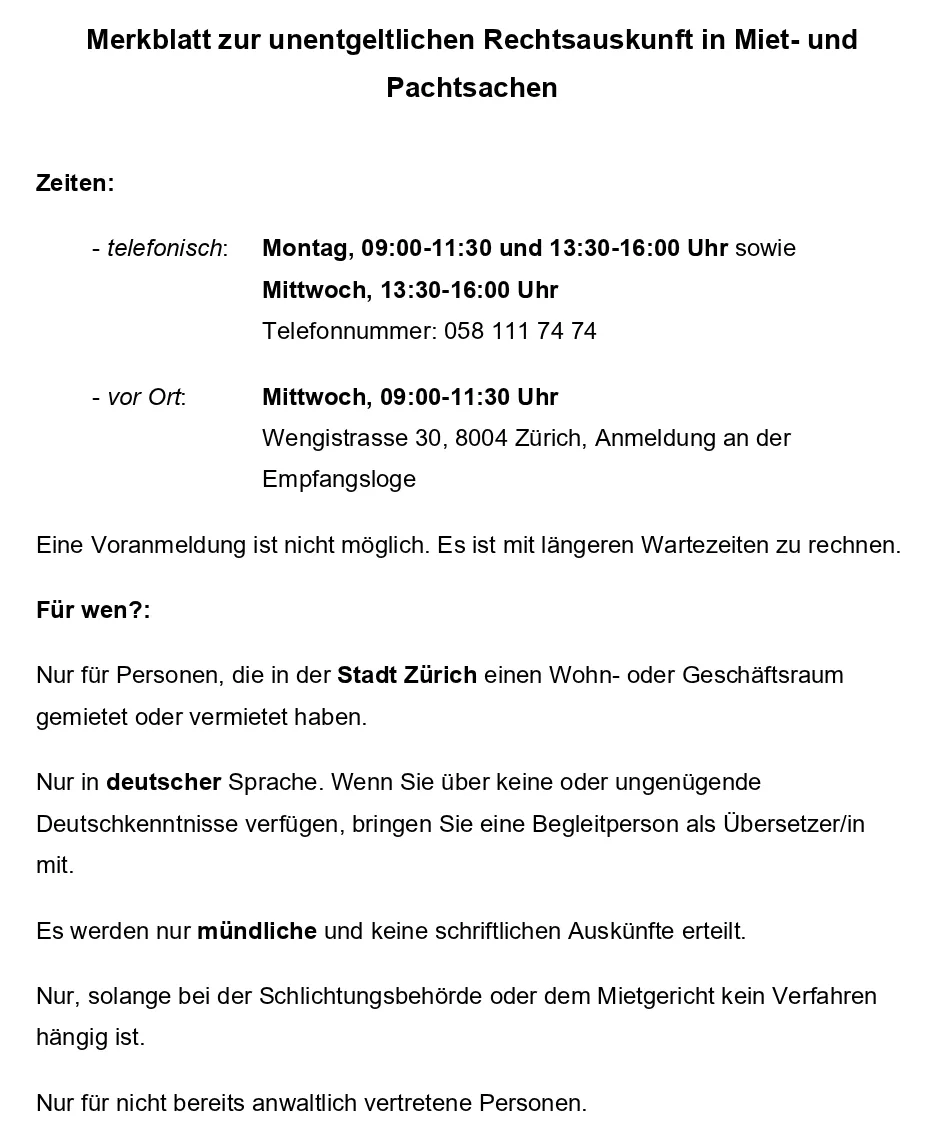
The leaflet sets the limits plainly. The desk is only for flats in the city of Zurich, works only in German (bring someone to translate if you need to), answers orally and never in writing, and closes to you once a case is pending or once you have a lawyer. It's neutral: the staff explain the law and the procedure but won't write letters, fill in forms or call your landlord for you. A talk lasts 15 minutes at most, so bring the lease and the letter you're asking about. If your flat is elsewhere in the canton, the courts send you to the conciliation authority of your district, which sets its own hours and conditions for this service.
The tenants' association, the Mieterinnen- und Mieterverband Zürich, is on your side rather than neutral. Its services range from a 20-minute personal consultation to representation by a lawyer. Members get the personal and the phone consultation free; a personal consultation costs non-members CHF 70. You book by phone on 044 296 90 20, Monday to Friday from 9:00 to 12:00 and 13:30 to 17:00. We come back to what membership is worth below.
The fourth option is evening help. The city of Zurich and the Zurich lawyers' association run a free 15-minute orientation at Strassburgstrasse 9 by Werdplatz. You get a slot at the reception the same day, from 16:30 Monday to Wednesday and from 17:00 on Thursday, and the talks run until 19:30 or 20:00. Slots are limited and can't be booked ahead. It covers any legal question, which makes it useful when a tenancy problem mixes with something else, such as a debt or a work contract.
All four point the same way when a dispute doesn't settle by itself: to the conciliation authority.
How the conciliation authority works
The conciliation authority (Schlichtungsbehörde) is the compulsory first stop for almost any dispute over a rented home in Switzerland, and it's free. In the canton of Zurich, each district court has one, and the one in the district where the flat is handles your case. It sits as a panel: a court clerk chairs it, with one member from a tenants' organisation and one from a landlords' organisation.
The Civil Procedure Code charges no court costs at this stage for disputes about renting homes, and no side is ordered to pay the other's lawyer. You start a case with a request that names the other party, what you want and what it's about. You can send it in writing or state it orally at the authority. The Zurich courts publish forms for each kind of case, with a digital assistant that helps you fill them in, plus sample letters for writing to your landlord.
The hearing has to take place within two months of your request, and it isn't public. You must attend in person, but you can bring a lawyer or someone you trust. The panel listens to both sides and pushes for a deal. In disputes over rent, notice, extensions or deposited rent, it can also propose a decision, which becomes binding unless a side rejects it within 20 days. If there is no deal, it records that and issues a permit to sue. The side holding the permit then has 30 days to take the case to the tenancy court. One twist: when you challenge a rent increase and no deal comes, the permit goes to the landlord, so it's the landlord who has to sue to get the increase.
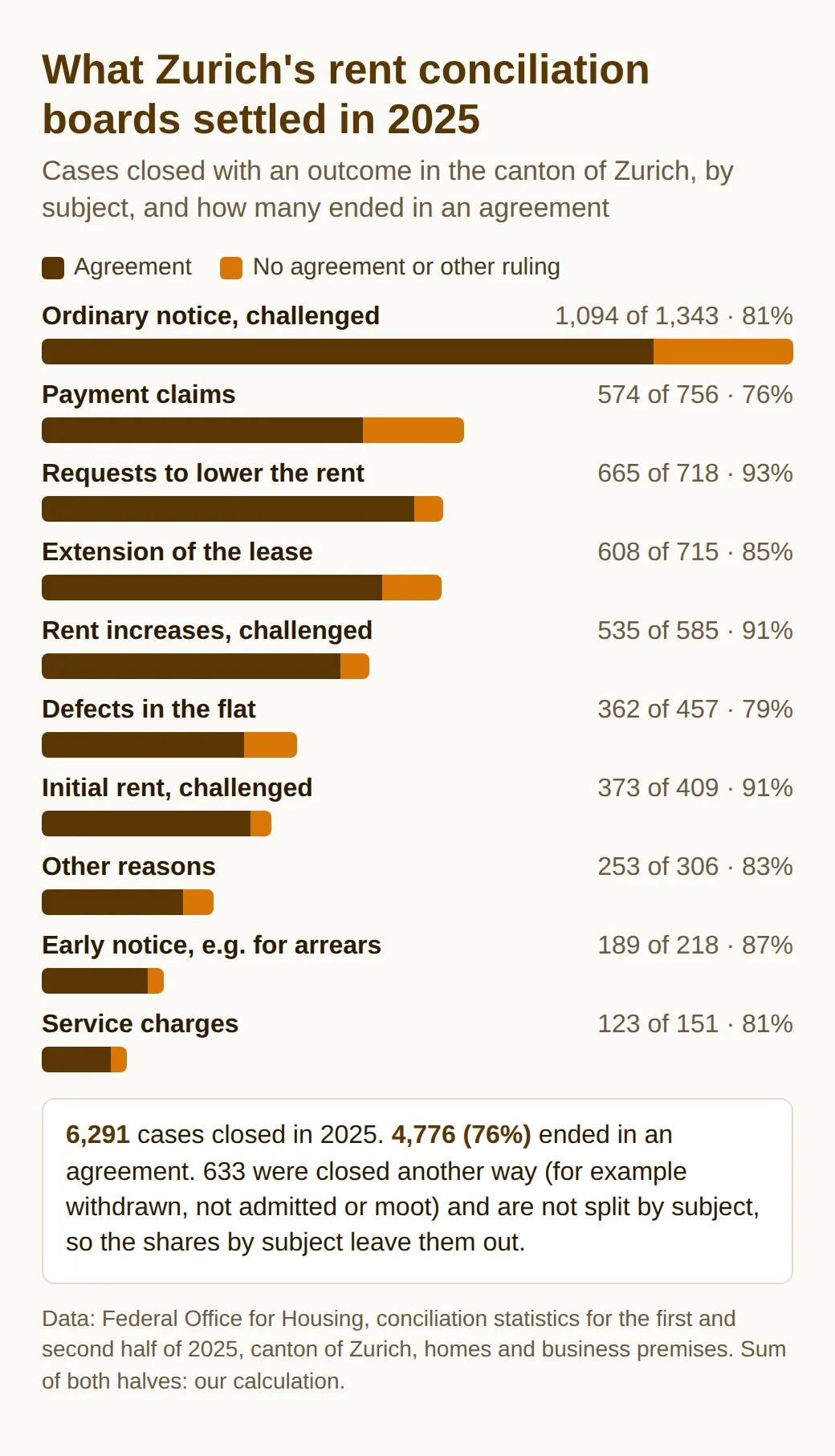
How often does it work? The Federal Office for Housing publishes half-yearly figures for every canton. In the canton of Zurich, 6,745 new cases came in during 2025 and 6,291 were closed. Of those, 4,776, or 76%, ended in an agreement, which the statistics define as a settlement, one side accepting the other's claim, or a claim withdrawn without conditions. Only 851 ended with no agreement and a permit to sue. In the second half of 2025, the rate was 73.2% in Zurich against 57.9% nationwide, so Zurich's panels settle more often than the Swiss average.
The figures cover business premises as well as homes, and an agreement isn't always a win: a tenant who drops a weak claim counts too. The statistics also don't split the 633 cases closed another way (withdrawn, not admitted or moot) by subject, so the shares by subject count only cases that reached an outcome. On that basis, requests to lower the rent and challenges of rent increases settled in more than nine cases out of ten. For most tenants, the hearing is where the matter ends.
The free part does end there, though. The exemption from court costs covers only the conciliation stage; the rules for the court stage leave tenancy disputes out. That's why the timing of joining the tenants' association matters.
When a lawyer, and the tenants' association, make sense
For most questions, the free desks and the hearing are enough. A lawyer becomes worth it when the stakes are high (a notice on a flat you've lived in for years, a large claim for damage) or when the landlord brings one. The tenants' association covers that through a legal insurance included in membership, and the timing rule is the part to know: the insurer only pays if you had been a member for at least 60 days when the dispute arose. Members then pay 10% of the costs themselves, at least CHF 100 and at most CHF 500.
So join before you need it, not after the notice arrives. Membership for a flat costs CHF 100 per calendar year. Between 15 September and 31 December, the CHF 100 already pays for the following year and the rest of the current year is free, with every service except the legal insurance available straight away. It renews each year and can be cancelled by 30 September for the end of the year.
Whatever help you choose, it only works if you use it in time.
The 30-day rule
Most tenant rights in Switzerland can only be used within 30 days, and once that window closes, the landlord's step usually stands. The clock starts the day a letter reaches you, not the day it was written.
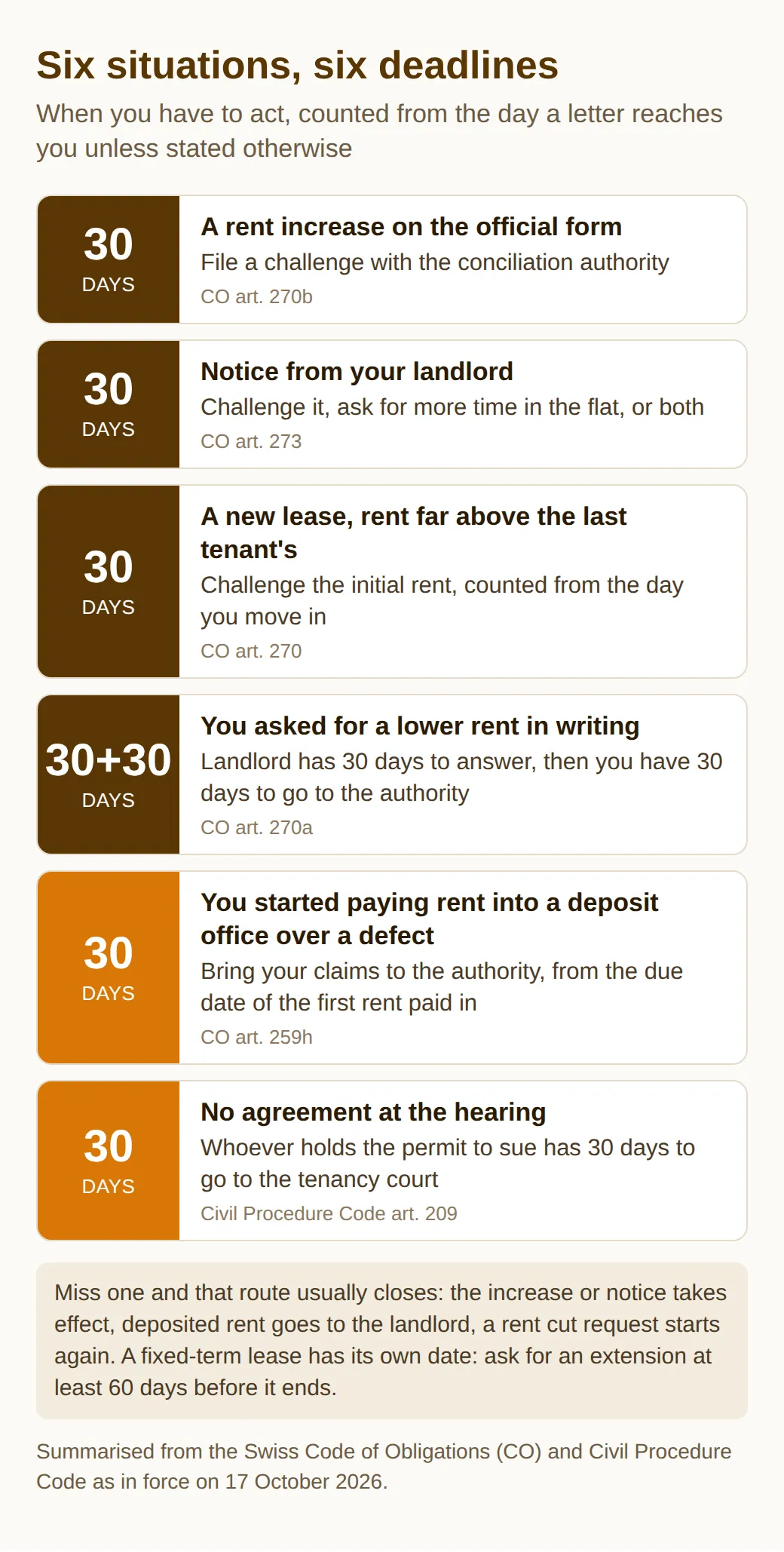
The safest habit is to file first and talk later. A request to the conciliation authority costs nothing and keeps your right alive, and you can still settle or withdraw it once you've had advice. Missing the deadline while you wait for the landlord to call back costs you the right itself. With that in mind, here are the limits the law puts on rent and notice.
Can your landlord raise the rent?
Yes, but only within tight rules, and an increase that breaks the formal ones is void. Under Article 269d of the Code of Obligations, the landlord can raise the rent only to the next date the lease could be ended. The increase must come on a form approved by the canton, with reasons, at least ten days before the notice period starts. In the canton of Zurich, that form comes from the Directorate of Justice. An increase without the form, without reasons, or with a threat of notice attached has no effect at all, and you don't need to challenge it. The Zurich courts add that the reasons must be specific: a landlord who cites several grounds has to put a figure on each.
The grounds themselves are limited too. A rent is abusive if it brings the landlord an excessive return. The usual grounds for a rise are higher mortgage costs, inflation and other cost increases. Each 0.25-point rise in the mortgage reference rate allows at most a 3% increase, and inflation may be passed on at up to 40% of the rise in consumer prices, according to the Federal Office for Housing.
If the form is in order but you think the increase isn't justified, you can challenge it within 30 days. While the case runs, your lease continues unchanged, old rent included. In 2025, Zurich's authorities recorded an outcome in 585 such cases, and 535 of them, or 91%, ended in an agreement.
As of October 2026, the reference rate is not the landlord's argument. It has stood at 1.25% since 2 September 2025 and was left unchanged on 2 September 2026. That puts the question the other way round.
Can you ask for a lower rent?
Yes, if your rent still rests on a higher reference rate than the current 1.25%. A falling rate doesn't lower your rent by itself; you have to ask. The rate behind your rent is usually written in the lease. If the rent has been adjusted since, the rate used for that adjustment counts. Anyone who signed or had a rent increase while the rate stood at 1.75% (from December 2023 to early March 2025) or at 1.5% is a candidate.
For each 0.25-point fall, the Federal Office for Housing puts the claim at 2.91% of the net rent in principle, with other rates for larger gaps. The landlord can set off cost increases and 40% of inflation since the last adjustment, so the real figure depends on your lease. The Zurich courts offer a rent calculator that does the sums. Heating and service charges aren't affected.
The procedure has two 30-day steps, set by Article 270a. You write to the landlord, ideally by registered post. The landlord has 30 days to answer. If they refuse, offer less, or stay silent, you have another 30 days to go to the conciliation authority; otherwise you start again. The cut takes effect from the next date your lease could be ended. A short letter does the job, and the court's German sample has the same structure:
Re: rent reduction, [address, flat]. My net rent of CHF [amount] is based on a reference interest rate of [1.75]%. Since 2 September 2025 the rate has been 1.25%. Under Article 270a of the Code of Obligations, I ask you to reduce my net rent accordingly from [next notice date]. Please reply within 30 days.
These requests are the cases most likely to settle: of the 718 Zurich rent-cut cases that reached an outcome in 2025, 665, or 93%, ended in an agreement. The Federal Office for Housing next publishes the rate on 1 December 2026, so check it before you write.
When your landlord gives you notice
A landlord's notice is valid only on the official cantonal form, and one sent as a plain letter, email or text message is void. The form requirement exists so that you learn how to defend yourself: the form explains how to challenge the notice and how to ask for more time. As the Zurich courts put it, protection against notice rests on three pillars: void notice, notice you can challenge, and an extension of the lease.
The landlord doesn't have to give a reason up front, but must give one if you ask, and the court has a sample letter for that too. Ask in writing straight away, because the answer shapes your case.
You can challenge notice that breaks good faith, and the law names typical cases. Notice is open to challenge when it's given because you asserted rights under the lease, to force through a rent increase, or because your family situation changed. The same goes for notice given during a tenancy case, or within three years after a case in which the landlord largely lost, withdrew, or settled with you. Those last two protections don't apply when the landlord urgently needs the flat for themselves or close family, when you're behind on rent, after a serious breach of your duties, when the building is sold, and in a few other cases.
Even valid notice can be softened. If moving out would be a hardship for you or your family that the landlord's interest doesn't justify, you can ask to extend the lease, by up to four years for a home, in one or two steps. The authority and later the court weigh, among other things, how long you've lived there, your personal and financial situation, the landlord's need and the local housing market, where Zurich's shortage can weigh in your favour. Both the challenge and the request for an extension must reach the authority within 30 days of receiving the notice. If it rejects your challenge, it checks on its own whether an extension is possible.
Notice was the most common subject before Zurich's conciliation authorities in 2025: 1,343 cases about ordinary notice reached an outcome, plus 715 about extensions. An extension buys time, not a flat, so start looking the week the form arrives. Our guide to finding an apartment in Zurich covers the search itself.
Defects: why you shouldn't simply stop paying
When something in the flat breaks, the landlord must fix it, unless it's a small repair or cleaning job that falls to you. The Zurich courts draw the line between those small jobs and medium or serious defects, which are the landlord's, unless you caused them. You can also ask for a rent reduction from the moment the landlord learned of the defect until it's fixed.
What you can't do is stop paying rent on your own: unpaid rent counts as arrears, and arrears can cost you the flat. The legal way to apply pressure is to deposit the rent: give the landlord a reasonable deadline in writing, and announce in writing that you'll otherwise deposit future rent with an office the canton designates. In Zurich, the conciliation authority issues a deposit instruction, and you pay the rent at the district court's cashier. Rent paid that way counts as paid. Then you have 30 days from the due date of the first deposited rent to bring your claims to the conciliation authority, or the money goes to the landlord. The Zurich courts have a form for the deposit and sample letters for reporting a defect. Talk to one of the advice desks before you start, because the steps have to be in the right order.
What may change for Zurich tenants
Nothing in your lease changes yet, but the rules on rent are under review. The Mietpreis-Initiative, a federal popular initiative submitted on 23 June 2026, wants a definition of abusive rent in the constitution and automatic, regular rent checks. On 25 September 2026 the Federal Council rejected it and announced a counter-proposal instead: a statistical comparison rent to judge initial rents, and indexation of rents during a tenancy. A draft goes out for consultation in the first half of 2027, and the bill is due before parliament by the end of 2027.
One change is already in force. Since 1 October 2025, the initial-rent form must also show the reference rate and the inflation figure the previous rent was based on. In the canton of Zurich, landlords have had to hand that form to new tenants since 1 November 2013. If you've just moved in and the rent jumped compared with the previous tenant's, the form gives you what you need to judge it, and you have 30 days from moving in to challenge the initial rent.
If a letter just arrived
Write down the day it reached you, and count 30 days from there. Check whether it came on the official form: a rent increase or a notice without one has no effect. Then call the court's desk on a Monday or a Wednesday afternoon, or book a consultation with the tenants' association, and bring the lease and the letter.
If the deadline is close and you're still unsure, file with the conciliation authority anyway. It's free, it keeps your rights open, and you can withdraw. And if you expect a dispute in the coming months, join the association now, so its legal insurance has passed its 60-day wait by the time you need it.
Common questions
Do I have to go to the conciliation hearing in person?
Yes, as a rule. You may bring a lawyer or a person you trust, but you have to be there yourself. If you filed the request and don't turn up, it counts as withdrawn. You can send someone in your place only if you live outside the canton or abroad, or if illness, age or another serious reason keeps you away. A landlord may send the property manager, as long as the manager has written authority to settle.
Can my landlord give me notice because I went to the conciliation authority?
Notice given while a tenancy case is running can be challenged, and so can notice given within three years after a case the landlord largely lost or settled. The same applies to notice given because you asserted your rights in good faith. There are exceptions, for example when the landlord urgently needs the flat for family or you are behind on rent.
Can the rent go up during a fixed-term lease?
Generally not. The Zurich courts explain that a landlord can only raise the rent to the next date the lease could be ended, so a fixed term blocks increases. The exceptions are rents that the lease ties to the consumer price index and staggered rents with steps agreed in advance.
Can I get help in English?
Not from the court's free advice desk, which works only in German and asks you to bring someone who can translate. The canton's official rent forms are in German as well. If your German is limited, take a German-speaking friend or colleague to any appointment and bring every letter you received.
What does it cost if the case goes on to court?
The conciliation stage is free, but that exemption stops there. At the tenancy court, costs can be charged, and the losing side may have to pay towards the other side's lawyer. That's where the tenants' association's legal insurance matters, provided you joined at least 60 days before the dispute arose.
More from the blog
All posts
Internet provider for your Zurich apartment: 2026 checklist
Before you choose an internet provider for a Zurich apartment: check fibre and cable at the address, find the socket ID, know the notice rules, order in time.

Quiet apartment in Zurich? Check the noise maps first
Is that Zurich flat quiet? Read the city's noise map spot by spot, the airport's runway hours and the legal limits, and know your rights if it gets louder.

Buy or rent in Zurich? The 2026 numbers for one flat
Buy or rent in Zurich in 2026: city prices against rents, the equity and one-third income rules, the 2029 end of imputed rent tax and one flat worked through.