Internet provider for your Zurich apartment: 2026 checklist
Socket first, provider second
In the city of Zurich almost every building has fibre and cable, so the network is rarely your problem; the socket in your flat is. Photograph the fibre socket's ID at the viewing, run the address through ewz's check, and order the day you sign: Init7, for one, needs two to four weeks for a new line where a socket is in place, and up to eight where it isn't.
That is the short version. The longer one starts from the wall rather than from prices and promotions, because what is installed in the flat you are renting decides when you get online.
What reaches a Zurich address
The city has two fibre owners and one cable network, and most buildings are on all three. ewz, the city's own utility, built the fibre network called ewz.zürinet together with Swisscom and finished it at the end of 2019. About 90% of properties, with 272,800 homes and business units, were connected. The two split the city between them, ewz building about three quarters and Swisscom a quarter, and wired each flat with four fibres so that both reach the same socket.
That split explains the provider lists you will see. ewz's network is open to any provider that wants to use it, and ewz's own zürinet page names nine: ClearMedia, GGA Maur, Giga Mobile, Init7, iWay, Leucom, Salt, SolNet and Sunrise. Swisscom isn't on it: under the four-fibre model it reaches the same sockets over its own fibre. Then there's the cable TV network of Sunrise (formerly UPC), which reaches the flat through a separate coaxial socket, the round TV plug.
We checked how complete this is with the federal broadband data. The Federal Office of Communications (OFCOM) publishes a broadband atlas that divides the country into squares of 250 by 250 metres. We took every square inside the city boundary for which the atlas lists fixed-network operators, 1,027 of them, with data as of 30 April 2026. Fibre reaches more than 90% of residential and business building entrances in 1,001 of those squares, and cable in 988. The operator lists name Sunrise in 1,021 squares, Swisscom in 1,017 and ewz zürinet in 971. In practice, the question in Zurich is almost never "is there fibre in this street?" It's whether the fibre goes all the way into your flat.
How do I check which internet is available at an address?
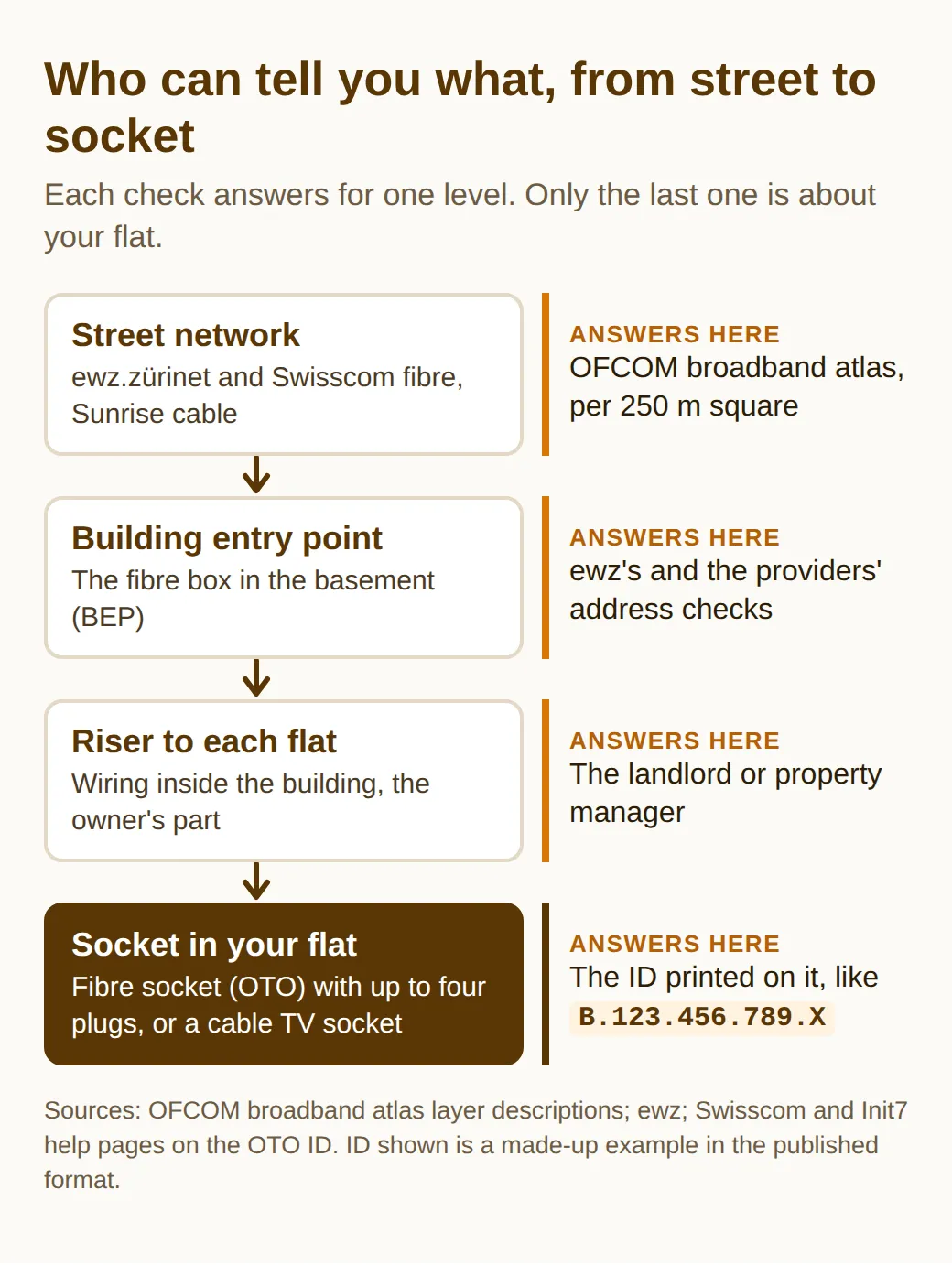
Use three checks, from the widest to the narrowest, and trust only the last. Each one answers for a different part of the path between the street and your wall.
The OFCOM atlas is the widest. It's neutral and free, but it works in squares, not addresses, and its own fibre layer description says the figures show fibre "at least as far as the building" and can't show whether it continues into the home. Operators also take part voluntarily, so one that sent no data is missing from the map. Use it to see which networks serve a neighbourhood, not to decide about a flat.
The address checks run by ewz and the providers come next. Type in the street and number and you get a yes or no for the building. Here is what ewz's check returns for its own head office:
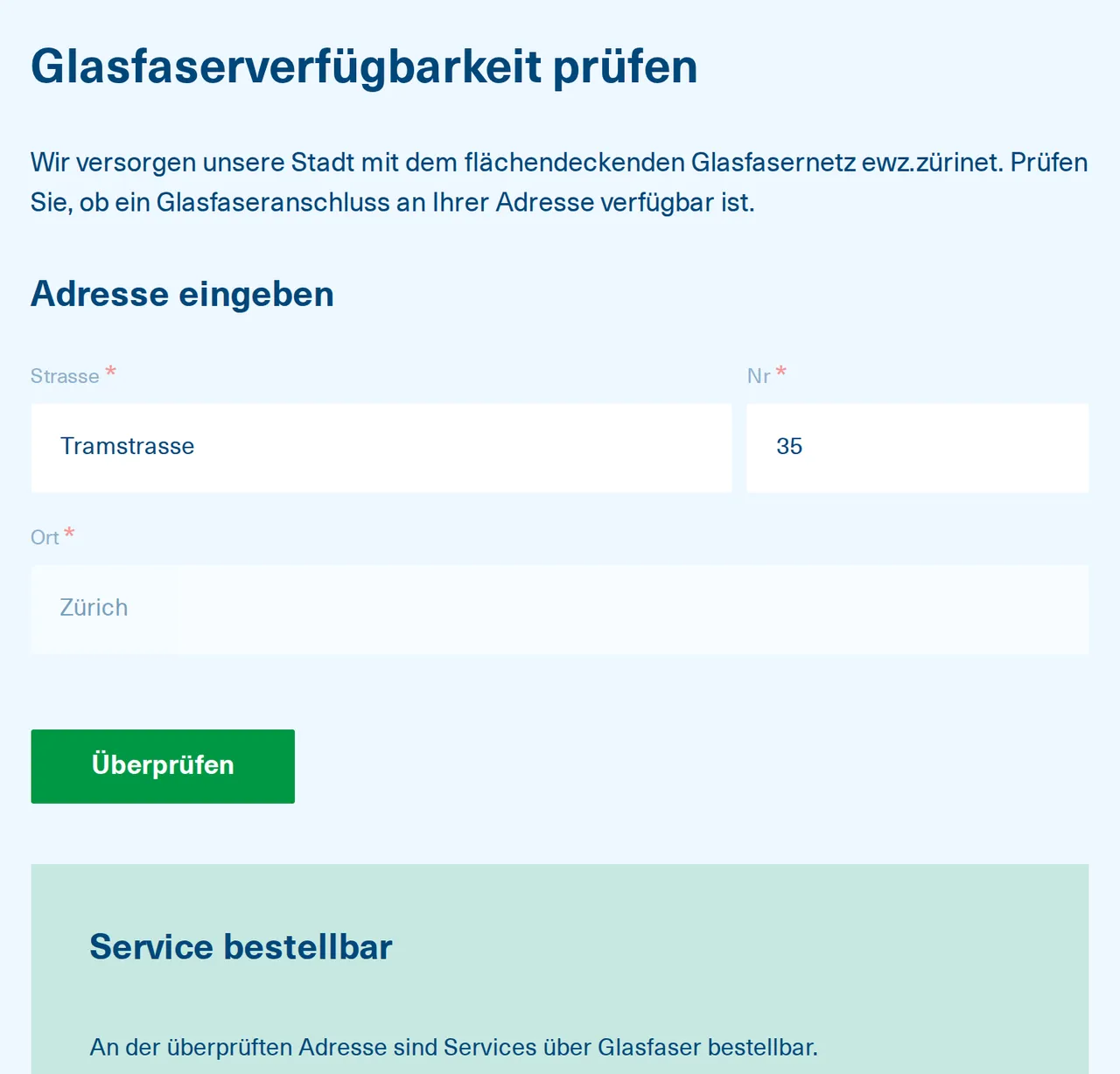
Service bestellbar, "service can be ordered", is good news, but notice what it covers: the building. It doesn't tell you whether the flat on the third floor has its socket installed, or whether the riser cable was ever pulled to it. The providers' own checks work the same way. Swisscom's fibre help page adds one useful signal: if its check shows no fibre information for an address, no rollout is currently planned there.
The narrowest check is the only one about your flat, and it isn't online at all. It's printed on the wall.
Why the socket in the flat decides
The fibre socket, called an OTO (optical telecommunications outlet), is where the network ends and your router begins. It has a unique ID, which Swisscom compares to a phone number. The ID is printed on the socket, and the socket itself usually sits in the living room or the entrance. The format looks like B.123.456.789.X, and Init7's explanation of the OTO ID notes that it often starts with A or B. The same page says the socket is marked with plugs 1 to 4, and in most cases only plugs 1 and 2 are actually spliced to a fibre.
That ID is what every provider asks for. Swisscom's moving page wants the "number on the fiber optic socket" for a fibre line, and only the previous resident's name for an old copper one. Sunrise's moving page asks for the OTO ID too, and tells you to get it from the landlord, the property manager (Verwaltung) or the previous tenant. With the ID, a provider knows exactly which line to switch on. For an old copper line, Sunrise warns, missing details mean the house connection has to be adjusted, and the electrician is billed on top of its CHF 99.90 moving fee.
So take a photo of the socket at the viewing, with the ID readable, and of the round cable TV socket if there is one. If you see no fibre socket at all, ask the property manager before you sign. A missing socket isn't a reason to walk away, but it changes your timetable by weeks, as the next sections show.
A flat without a socket is a job for the building owner. ewz's answer to "what do I do if my apartment doesn't have a fibre optic socket?" is to contact the owner or management so that they ask ewz to connect the property, or have a certified installation partner do the work in your flat. ewz says only its certified partners may do the building wiring, and for renovations the job goes to whichever of Swisscom or ewz built the fibre in that part of the city. For the tenant, that usually means a phone call to the management and some patience, not a bill: Init7 says ordering its service triggers the in-house cabling, done by a third party and "normally free" for the customer.
What the landlord must allow, and what you can refuse
The landlord can't simply refuse a provider that wants to wire your flat and pays for it. Under Article 35a of the Telecommunications Act, building owners must, as far as reasonable, tolerate further connections into the flats when a provider asks for one and pays for it. The tenants' association, the Mieterinnen- und Mieterverband, puts it plainly: you can't make the network operator connect the building without the landlord's consent, but the landlord must give it if the costs are covered, and in practice operators usually build the connection free of charge. Where the building is already connected and the landlord drags their feet over your flat, the association suggests going to the network operator, which will then remind the landlord of the obligation.
The same law protects you from paying for a network you don't use. In many rented flats, the tenants' association notes, the cable TV connection is billed through the service charges, often without tenants noticing. Article 35a says no usage fee may be charged if you don't want to use a new connection from the start, or once the connection has been cancelled, with a reasonable notice period. An unused socket can be sealed, and neither sealing nor unsealing may be charged. Sunrise's own terms for internet and TV confirm that customers may have unused cable sockets sealed, a step called Plombierung.
The tenants' association says sealing can save several hundred francs a year, and it describes the route. Write to the landlord, who usually sends a technician to seal the socket, and send a copy to the cable operator, ideally by registered post. If you pay service charges on account, they should fall after the sealing. If they're a flat rate, ask for the flat rate to be removed by the next notice date; if the cable fee is part of the net rent, ask for a rent reduction. The association has sample letters for both cases on that page. Read your lease and your last service charge statement first, so you know which case you're in. For anything that turns into a dispute with the landlord, our guide to free tenancy advice in Zurich lists where to call.
Once the wall is sorted, the paper is the next trap.
Minimum term and notice: what you sign up to
Home internet contracts often tie you in for 12 or 24 months, and leaving early costs either a flat fee or the monthly fees up to the end of the term. That's the general picture from ombudscom, the telecom conciliation body, which also warns that a contract not cancelled in time is usually extended. The length and the notice period are whatever the provider's contract and terms say. Here is what three of the largest publish:
| Provider | Minimum term | Notice | Moving |
|---|---|---|---|
| Swisscom | usually 12 months, can be 24 with a discounted device | 60 days for most subscriptions | report at least 10 days ahead; free online, CHF 99.90 in a shop |
| Sunrise | 12 months unless the offer says longer | two months to a month-end, not before the term ends | CHF 99.90 processing fee, electrician extra |
| Salt Home | 24 months plus the current month | 60 days to a month-end after the term | not stated in the factsheet |
Swisscom's cancellation page says that if you cancel inside the minimum term or outside the notice period, you're billed the remaining monthly fees. Sunrise's terms say the same, and two more details catch people out. Its cancellation page accepts a cancellation only by phone or live chat, never by letter or email, and its terms say that for a contract with a term of 12 months or more you may not send it earlier than six months before the end. Salt's factsheet for Salt Home, dated September 2025 and linked from its fibre page, sets 24 months from activation and activation fees of up to CHF 99.90.
Moving is where a long term bites. In May 2024 SRF's consumer programme Espresso reported on a couple in Basel-Landschaft who wanted to take their Salt Home fibre plan, about CHF 40 a month on a 33-month minimum term, to a larger flat. The new address had no fibre, so Salt ended the contract and then billed them CHF 99.95 in shutdown fees for early termination. The terms Salt had sent them said nothing about it; the fee appeared only in a Salt Home product brochure. In Zurich, where nearly every building has fibre, the risk is smaller, but the lesson stands: before you sign a 24-month contract, check that the next flat you're likely to move to would be served, and read what the terms say about moving.
If you only need internet for a few months, a 24-month term is the wrong tool. Ask whether a furnished or temporary flat already has a working line in the rent; our guide to furnished and temporary flats covers the rules for that kind of stay.
How to avoid weeks offline after moving in
Order when you sign the lease, not when you get the keys: the weeks in between are the time the providers say they need.
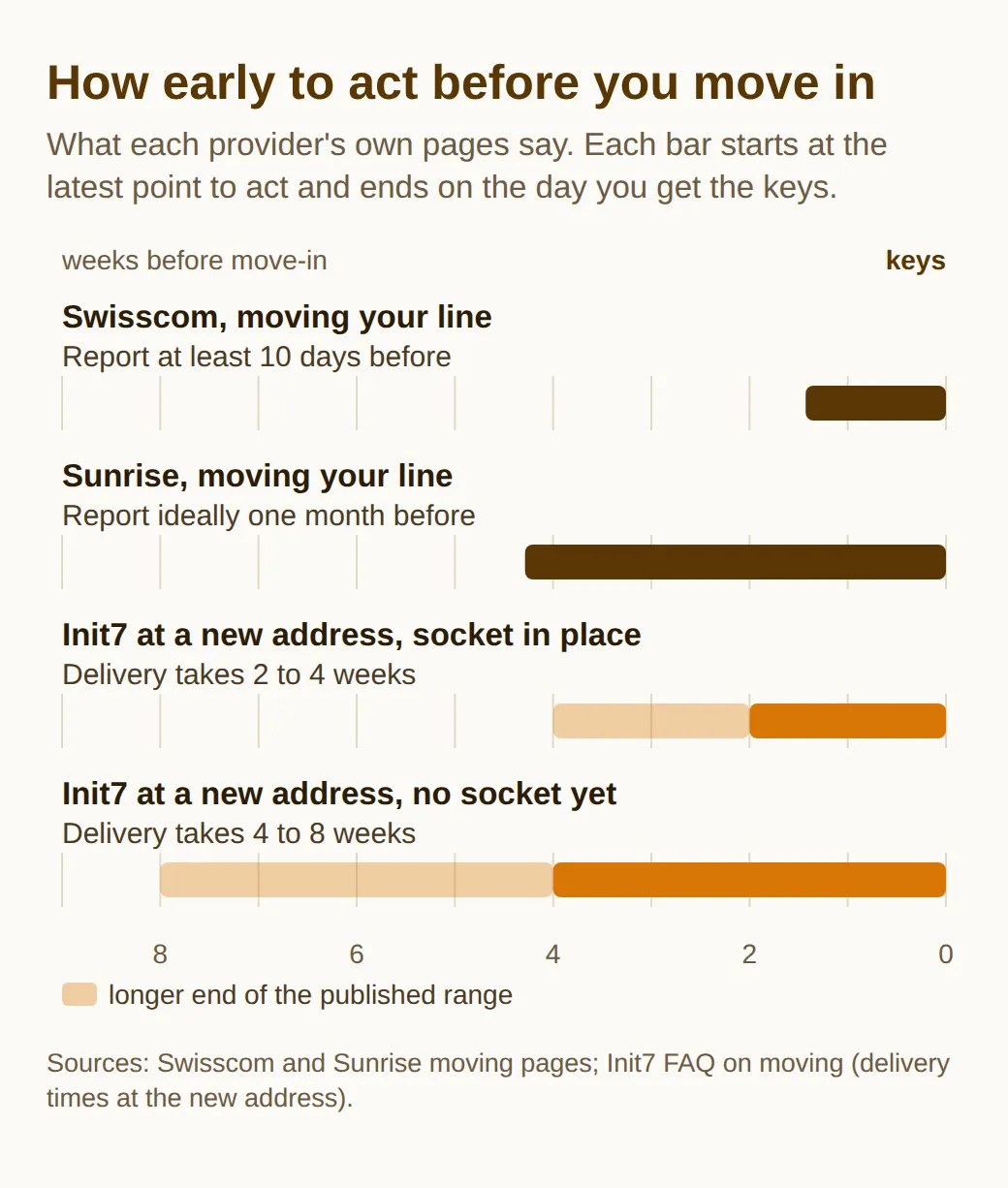
The published lead times differ more than you'd expect. Swisscom asks you to report a move at least 10 days before your moving date. Sunrise suggests one month and switches off the line at the old address on the switch date you choose. Init7's moving FAQ gives the clearest numbers for a new line: two to four weeks where an OTO socket is already in place, four to eight weeks where it isn't. A move with Init7 also costs the setup fee again (CHF 77 for its 10 Gbit/s service) and starts a new 12-month term at the new address. The socket you photographed at the viewing is what puts you in the faster row.
Four habits close most of the gap. Send the OTO ID with your order or moving notice, so nobody has to visit just to identify the line. Set the activation date to the key handover, as Swisscom's own moving checklist suggests, so the line is live when you first walk in. Ask the outgoing tenant whether they plan to cancel or hand over their line: Init7, for one, lets the next tenant take over an existing line, on a new contract with a 12-month minimum term. And plan a fallback for the first days. Sunrise itself suggests using your phone as a mobile hotspot, with the warning that it only makes sense if your mobile plan includes unlimited data, since otherwise extra charges apply.
If you're arriving from abroad, the order of events is slightly different. You may sign the lease before you have a Swiss bank account or a Swiss phone number. Swisscom says its Expat Service sets up internet, TV and mobile even if you don't yet have a permanent residence permit. Other providers set their own rules, so check before you count on it. Our guide to finding an apartment in Zurich covers the documents you'll be collecting at the same time.
From viewing to first login
At the viewing, photograph the fibre socket with its ID, and the cable socket if there is one. Ask the property manager two questions: whether the fibre is connected to this flat, and whether the cable fee is part of the service charges. Before you sign, run the address through ewz's check and one provider's check, and if there's no socket, ask the management to commission it now, not after you move in.
On the day you sign, pick a contract whose term fits how long you expect to stay, and note the last day you could cancel it. Order the line or report your move with the OTO ID and the key date. If you won't use the cable TV socket, write to the landlord to have it sealed and the fee removed. And keep a mobile hotspot ready for the first days, because the published lead times are ranges, not promises.
When you get to comparing offers, do it with the socket ID in hand. A price list can't tell you what's on the wall.
Common questions
Can I take over the previous tenant's internet line?
Sometimes, and it can save you a new order. Init7 lets the next tenant take over an existing line through a change of holder, on a new contract with a 12-month minimum term, and Swisscom lets its customers transfer an internet connection to another private person. Ask the outgoing tenant early, because once they cancel or move their line, the socket may sit unused until you order your own.
Should one flatmate sign the internet contract for the whole shared flat?
It is usually simpler. The telecom conciliation body ombudscom points out that when two people share one connection, both can be held liable for the whole bill, and each needs the other's consent to change or cancel. One named holder who collects shares from the others keeps it clear, especially when people move out at different times.
Do I need a Swiss residence permit to order home internet?
Not always. Swisscom says its Expat Service sets up internet, TV and mobile even if you don't yet have a permanent residence permit. Other providers set their own rules, so check the order page before you rely on it.
Where can I complain if a provider charges a fee I never agreed to?
First complain to the provider in writing and keep the answer. If that fails, ombudscom, the conciliation body for telecoms, can mediate. A request costs CHF 20, takes one to two months on average, and your last contact with the provider must be less than 12 months old.
More from the blog
All posts
Quiet apartment in Zurich? Check the noise maps first
Is that Zurich flat quiet? Read the city's noise map spot by spot, the airport's runway hours and the legal limits, and know your rights if it gets louder.

Buy or rent in Zurich? The 2026 numbers for one flat
Buy or rent in Zurich in 2026: city prices against rents, the equity and one-third income rules, the 2029 end of imputed rent tax and one flat worked through.

Airbnb rules in Zurich 2026: can a tenant let their flat?
Airbnb rules in Zurich for tenants: landlord consent, how often and at what price, the city's 2026 zoning rule, guest registration and the City Tax.