Furnished apartments in Zurich: 2026 prices and your rights
Before you book
Expect to pay roughly 15 to 20 percent more than for the same flat empty. On 17 October 2026, the median furnished flat of 2 to 2.5 rooms on our Zurich board asked CHF 2,720 a month, against CHF 2,350 unfurnished. Unless it's a holiday flat let for three months or less, Swiss tenancy law protects you just as it would in an unfurnished one.
That last point is easy to miss. A furnished flat, a serviced apartment and a sublet can look identical in a listing and sit on very different contracts. This guide covers what you pay, which kind of contract you're signing, and the checks that keep a short stay from becoming an expensive one.
What does a furnished apartment cost in Zurich?
Furnished costs more at every size we looked at, and the gap widens as flats get bigger. We took every flat for rent in the city of Zurich on our board on 17 October 2026, 2,004 listings of which 527 were marked furnished, removed duplicates, and compared median asking rents by number of rooms.
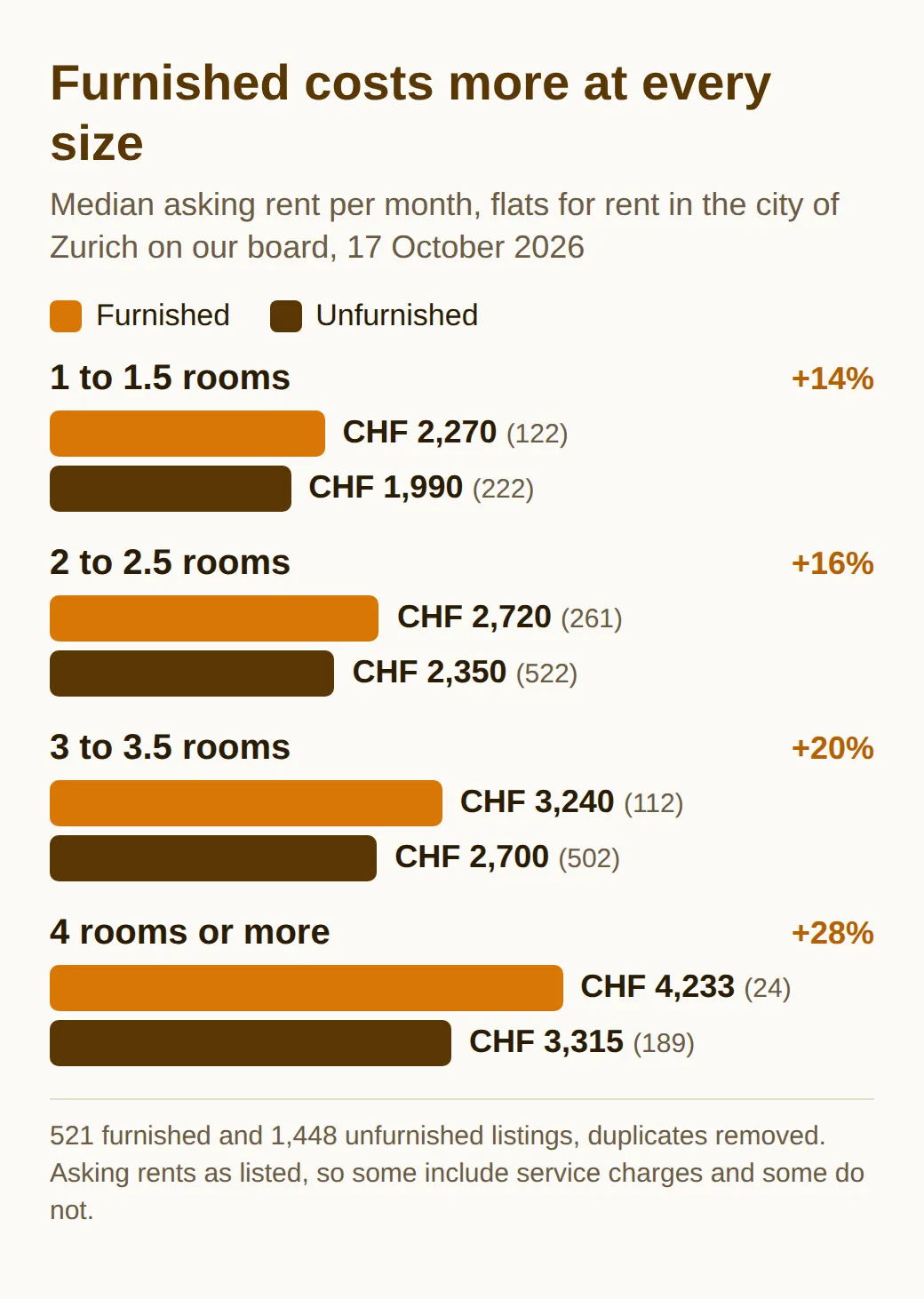
The premium is 14% for one-room flats, 16% for two rooms and 20% for three. The four-room figure rests on only 24 furnished listings, so take it as a hint rather than a price. Measured per square metre, for listings that gave their area, the furnished median was CHF 46 a month against CHF 39, about 18% more.
Not all of that is furniture. A furnished price may cover electricity, internet or cleaning that an unfurnished tenant pays separately, and listings don't state rents the same way: some include service charges, some don't. The tenants' association notes in its glossary that if a lease lists no service charges at all, they are included in the net rent. So before you compare two offers, ask each landlord what the monthly figure covers.
For scale, Statistik Stadt Zürich's 2026 rent survey puts a 75 m² flat let to a new tenant in an older building at about CHF 2,287 a month in net rent, and in a new building at about CHF 2,907. Those are signed contracts surveyed on 1 April 2026, and the city points out that advertised rents are usually clearly higher than the rents in its survey.
What the premium buys you is time and freedom from logistics: nothing to buy, ship or sell when you leave. Whether that's worth a fifth more rent depends on how long you'll stay, and on which kind of furnished place you take.
Four kinds of furnished offer
"Furnished" covers four quite different things in Zurich, and the difference shows up in your contract, not in the photos. There's the plain furnished flat, let with its furniture by an owner or a property manager like any other flat. There's the serviced apartment, sometimes called a business apartment, run as a business. There's the sublet, where a tenant lets you their own flat while they're away or after they've moved on. And there's the furnished room, usually in a shared flat.
The serviced apartment is the one that has grown. Statistik Stadt Zürich counts these as "apartments": in its method notes, furnished flats that are professionally managed and mostly let for shorter periods, many with cleaning, laundry or concierge services. The city counted 3,470 of them in 2020, 4,710 in 2023 and 5,320 in 2025, now 2.2% of all flats. About a fifth are in district 4, and in the Langstrasse quarter they make up 8.4% of all flats. Oerlikon, outside the centre, went from 100 to 370 in five years. For how the districts compare as places to live, see our guide to the best neighborhoods in Zurich.
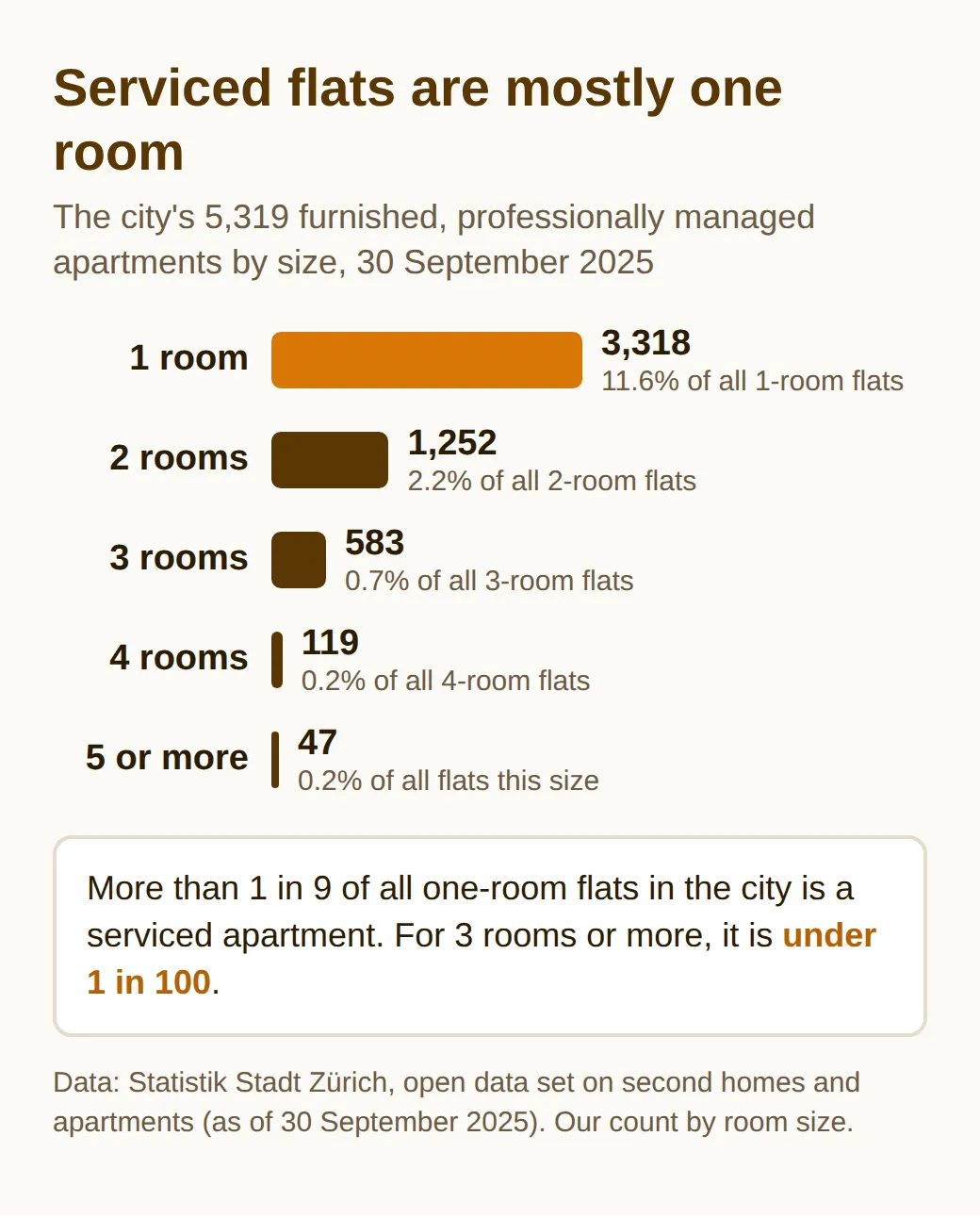
The city's open data shows what that stock is made of. Of the 5,319 apartments in the raw data for 30 September 2025 (the city rounds to 5,320), 3,318 had a single room, and more than one in nine of all one-room flats in the city was a serviced apartment. Only 749 had three rooms or more. If you're coming alone for a project, you'll find plenty. If you're moving with a family and want furnished, the serviced segment shrinks to a few hundred flats across the whole city, and a plain furnished flat or a sublet is the likelier route.
The rules for owners changed in 2026. Since 1 September 2026, flats let regularly and commercially for less than a year, such as business apartments and Airbnb flats, no longer count toward the minimum share of housing the city's zoning rules require. Owners must report that use, and turning a flat into a business apartment needs a building permit even when nothing is built. The Federal Supreme Court upheld the rule on 30 April 2026. None of this changes your contract as a tenant. Which contract you have is the next question.
Does Swiss tenancy law apply to a furnished flat?
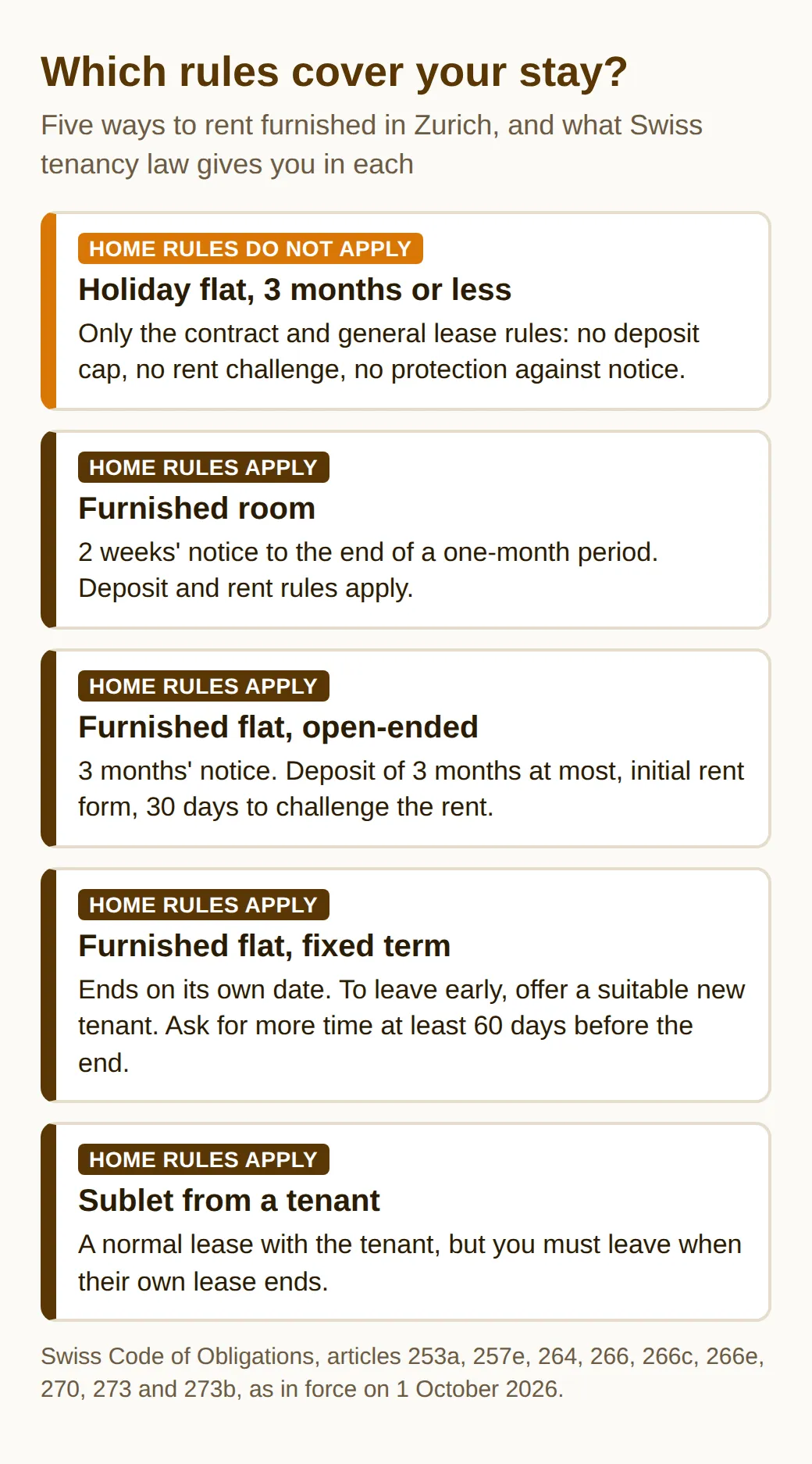
Yes. The Code of Obligations says the rules on renting homes also cover the things a landlord lets together with the rooms (art. 253a), so the furniture is part of the lease, not a side deal. The same article makes one exception: holiday flats rented for three months or less. That's the line to watch.
A holiday let under that line runs on its contract and the general rules for any rental. The protections built for homes, from the deposit cap to the right to challenge the rent, don't apply. Above it, a furnished flat you live in is covered like an empty one. The name on the paper doesn't decide this: Swiss contract law looks at what the parties really agreed, not at a wrong label used by mistake or to hide what the contract is (art. 18). A six-month "booking" of a flat you live in for work isn't a holiday let because the provider calls you a guest.
One practical tell is VAT. Swiss VAT law exempts the letting of flats but taxes rooms let to accommodate guests, at a special rate of 3.8%. An invoice with that line means the provider bills you as a guest. That doesn't settle which rules govern your stay, and where a provider adds hotel-style services, whether the deal counts as a lease can be argued either way; we found no official guidance that settles it. If it matters to you, for instance because you want to challenge the price, get advice from the tenants' association before the 30-day deadline for that runs out.
Once you know you're a tenant, the next thing to check is how and when you can leave.
Notice periods: room, flat or fixed term
How fast you can leave depends on what you rented, not on the furniture. A furnished room can be ended with two weeks' notice to the end of a one-month period. A furnished flat, like any flat, takes three months' notice to a local termination date. That gap surprises people who assume furnished means flexible.
A furnished flat or a serviced apartment may also be let for a fixed term. A fixed-term lease ends on its date without anyone giving notice, and if both sides simply carry on after that date, it becomes open-ended (art. 266). Before the end date you can't give notice unless the contract allows it. What you can do is hand the flat back early and propose a new tenant who can pay, whom the landlord can reasonably accept, and who takes over on the same terms; then you're released (art. 264). Without one, you pay until the lease ends, minus what the landlord saves or earns by letting the flat again.
A fixed term binds the landlord too: they can't end it before its date, short of the law's extraordinary grounds such as unpaid rent. And if leaving at the end would be a real hardship, you can ask for an extension even of a fixed-term lease. The request must reach the conciliation authority at least 60 days before the end, and extensions for homes add up to four years at most. One clause blocks that route: a lease signed expressly only until a planned renovation or demolition starts can't be extended. If your contract ties its end to building works, read that clause twice before you sign.
The end date is one half of the contract. The money you hand over at the start is the other.
The deposit, the rent form and the price
The deposit cap applies to furnished flats as well: at most three months' rent, paid into a bank account in your name, not the landlord's. For a furnished 2-room flat at the median asking rent, that's at most CHF 8,160. A provider who wants a larger "security" on a lease is asking for more than the law allows.
In the canton of Zurich, every new lease of a home must come with an official form that tells you the previous tenant's rent, a duty in force since 1 November 2013. The form is your evidence if the price looks out of line. You can challenge the initial rent at the conciliation authority within 30 days of moving in, if you signed because of the tight market or because the landlord raised the rent sharply over the previous one. The tenants' association counts a rise of more than 10 percent as strong, and advises getting advice before you file. In disputes over a home, the conciliation stage carries no court costs.
The law has no separate formula for what furniture may add. For sublets, the Zurich courts spell out the principle: the subletting tenant may not make a profit that isn't justified by what they provide. Furniture left for you is part of what they provide, so a sublet at the main rent plus a fair amount for the furniture should stay within that rule. A sublet far above it needs a reason, and a landlord may refuse consent to a sublet whose terms are abusive. Sublets carry a few more risks of their own.
Sublets: a lease that hangs on another lease
A sublet is an ordinary lease between you and the tenant, with the same forms and protections. The Zurich courts are explicit that the subletting tenant must use the official initial rent form too, and that you can ask for an extension even of a fixed-term sublease. The catch is that your right to live there depends on the main lease. If the main lease ends, you have to leave when the landlord asks, and an extension of your sublease can't run past the main one (art. 273b). If the tenant stops paying the landlord, the tenants' association warns, you can lose the flat even though you paid every month.
There's one exception that matters for sublets run as a business. If a sublease mainly serves to get around protection against notice, you're protected regardless of the main lease, and if the main lease is ended, the landlord steps into your contract.
Before you pay a deposit on a sublet, ask for three things: the landlord's written consent to the sublet (art. 262), a copy of the main lease so you can compare the rent, and a written sublease. The courts note that a tenant who sublets without consent risks notice, and with it your home. A tenant who lets you in also has to report your move-in to the city within 14 days under the Drittmeldepflicht, which you'll need for the next step.
Registering from a furnished flat
If you move to Zurich from abroad, you must register within 14 days at the residents' office, the Personenmeldeamt, in person and by appointment. Bring your passport or ID card and a lease, sublease or move-in notice (Einzugsanzeige), plus your employment contract or proof of studies. The fee is CHF 40 per adult, and the migration office charges its own fees for your permit. Your name doesn't have to be on the lease: if you live in someone else's flat, the landlord or host confirms your move-in online.
Two details matter for a furnished stay. You can only register once Zurich is really where you live, so book the flat first. And the city warns that appointments are sometimes only available after the 14 days have run out. Book the next free one anyway and ask for an extension through its contact form.
Registering is more than paperwork. A Zurich address is what lets you order the debt-collection extract that landlords ask for when you apply for a permanent flat, as our guide to finding an apartment in Zurich explains.
Checks before you sign or pay
A few minutes before you sign save most of the trouble later. Our guide to finding a flat covers the scams that target newcomers; these checks are specific to furnished stays:
- Price: ask for rent, service charges and services as separate amounts, and whether the charges are a flat rate or advance payments with a yearly statement.
- Term: note the end date, any notice clause, and whether the lease ends when building works start.
- Deposit: no more than three months' rent, paid into a blocked account in your name.
- Rent form: ask for the canton's form with the previous rent, and keep it.
- Inventory: walk through the furniture list with photos and sign it with the landlord at move-in.
- Sublet: get the landlord's written consent and see the main lease before you pay anything.
The inventory deserves a word. At the end you must return the flat in the state that comes from normal use, and a clause that makes you pay a fixed amount for more than actual damage is void. A worn mattress after a year is normal use. A burned worktop isn't. Photos dated at move-in are what settle the difference.
A sensible first year
Use a furnished flat as a bridge, not as a home you drift into. Book it for a fixed term a little longer than you expect your search to take, and register your address as soon as you move in. Start looking for an unfurnished flat in your first weeks rather than your last: tenants must give three months' notice, so many flats are advertised long before they're free. The University of Zurich also advises having a temporary place for your first days or weeks.
If you stay longer than planned, ask the landlord before the end date whether the lease can continue, and get the answer in writing. And if a stay that started as a holiday booking has turned into your home, look at the contract again: the exception covers holiday flats rented for three months or less, not the place you now live in.
Common questions
What does an all-inclusive rent mean in a Swiss lease?
Usually that service charges are paid as a flat rate rather than as monthly advance payments. With a flat rate you get no yearly statement, so you can't claim money back if heating cost less than expected. The tenants' association advises asking what the charges actually cost over the last three years. If a lease lists no service charges at all, they are included in the net rent.
Who pays if the furniture gets damaged?
You return the flat in the state that comes from normal use, so ordinary wear on a sofa or a mattress is the landlord's cost. You pay for damage beyond that. A clause that makes you pay a fixed fee at the end for more than the actual damage is void, so an inventory list with photos, signed at move-in, is your best evidence.
Do I need to register if my employer sends me to Zurich for a few weeks?
Not if you are an EU or EFTA citizen, or posted by a company based there, and your employer has reported you through the online notification procedure, which covers up to 90 working days a calendar year. Once you work in Switzerland for more than 90 days, you need a residence permit and must register with the city in person. Ask your employer which applies to you before you book a furnished flat.
When do I get my deposit back after a furnished stay?
The bank releases the deposit when you and the landlord both agree, or on a final court ruling or payment order. If the landlord has made no legal claim against you within a year of the end of the lease, you can ask the bank to pay it out to you directly.
More from the blog
All posts
How to find an apartment in Zurich: the 2026 guide
How to find an apartment in Zurich in 2026: what a 0.11% vacancy rate means, the debt extract, what landlords may ask, city flats, deposits and scams.
Student housing in Zurich 2027: WOKO, JUWO, WG rooms ranked
Student housing in Zurich ranked by rent and chances: WOKO, JUWO, exchange rooms due 15 November, WG rooms at a CHF 1,295 median, and the sublet rules.
Internet provider for your Zurich apartment: 2026 checklist
Before you choose an internet provider for a Zurich apartment: check fibre and cable at the address, find the socket ID, know the notice rules, order in time.