Best neighborhoods in Zurich: 12 districts compared (2026)
In one minute
There is no single best district in Zurich, but the city's own figures narrow it fast. For a quiet, green area without the top rents, look at Kreis 10 (Höngg, Wipkingen), the best value, and Kreis 6. Kreis 7 and Kreis 2 are the greenest and among the quietest, at a premium. Kreis 4 and 5 are the liveliest, and the loudest. Kreis 12 is the cheapest.
Most lists of the best neighbourhoods in Zurich are written for visitors. They tell you where the cobbled lanes and the bars are, and say nothing about what a flat costs, how loud the street is at night or which school your child will go to. We went to the numbers instead: the city's 2026 rent survey, its 2025 survey of over 5,000 residents, its population register and the public transport timetable. We link each source where it first comes up.
How Zurich's districts work
The city of Zurich is divided into 12 districts, called Kreise (one Kreis), and each is split into quarters, 34 in all. Kreis 1 is the old town, Kreis 2 and 8 face each other across the lake, and Kreis 11 and 12 lie in the north of the city. Kreis 11 is the biggest, with 80,964 residents at the end of 2025 according to the city's population data. Kreis 1 is the smallest, with 5,747. The whole city had 452,421.
Two things are the same everywhere, and both matter before you pick a favourite. First, flats are scarce in every district. On 1 June 2026, the city's vacancy count found 252 empty flats out of 238,459, and no district came close to half a percent: the share ranged from 0.05% in Kreis 5 to 0.15% in Kreis 6. Second, the whole city is one public transport fare zone, 110, so moving from Kreis 1 to Kreis 12 doesn't change what you pay to get around.
So the choice is about everything else: what you pay for the flat, how the street feels, and how long the trip to work takes. Rent comes first, because it rules out the most.
What a flat costs in each district
For a 3-room flat, the gap between the cheapest and the dearest district is about CHF 1,300 a month. Statistik Stadt Zürich surveys rents on 1 April every two years, and its 2026 survey breaks them down by district in its open data. Here are the medians for flats from private landlords, net rent per month (without heating and other service charges):
| District | 2 rooms | 3 rooms | 4 rooms |
|---|---|---|---|
| Kreis 1, Altstadt | CHF 2,194 | CHF 2,855 | CHF 3,489 |
| Kreis 2, Enge, Wollishofen, Leimbach | CHF 1,770 | CHF 2,272 | CHF 2,693 |
| Kreis 3, Wiedikon | CHF 1,636 | CHF 1,883 | CHF 2,517 |
| Kreis 4, Aussersihl | CHF 1,784 | CHF 1,986 | CHF 2,584 |
| Kreis 5, Industriequartier | CHF 1,800 | CHF 2,378 | CHF 2,598 |
| Kreis 6, Unterstrass, Oberstrass | CHF 1,864 | CHF 2,120 | CHF 2,874 |
| Kreis 7, Fluntern to Witikon | CHF 1,800 | CHF 2,230 | CHF 2,606 |
| Kreis 8, Riesbach | CHF 2,083 | CHF 2,400 | CHF 3,091 |
| Kreis 9, Altstetten, Albisrieden | CHF 1,660 | CHF 1,953 | CHF 2,400 |
| Kreis 10, Höngg, Wipkingen | CHF 1,589 | CHF 1,804 | CHF 2,081 |
| Kreis 11, Oerlikon, Seebach, Affoltern | CHF 1,545 | CHF 1,801 | CHF 2,117 |
| Kreis 12, Schwamendingen | CHF 1,415 | CHF 1,576 | CHF 1,872 |
| Whole city | CHF 1,670 | CHF 1,950 | CHF 2,434 |
Read these as a ranking, not as your rent. The medians include tenants who moved in decades ago, and a newcomer pays more. Across the city, a 3-room flat from a private landlord in an existing building, let to a new tenant within the last two years, has a median net rent of CHF 2,250, against CHF 1,950 for all private tenancies, about 15% more. Add service charges too: the gross median for the same 3-room flat is CHF 2,170. Flats from non-profit landlords, such as the city and the cooperatives, cost far less, with a city-wide median of CHF 1,066 for three rooms, but how you get one is a story of its own, told in our guide to finding an apartment in Zurich.
The pattern is clear enough. The lake and the slopes above the centre (Kreis 1, 2, 7 and 8) cost most, the old working-class districts around the main station sit near the middle, and the north and west (Kreis 9 to 12) are at or below the city median, with Kreis 12 the cheapest. Kreis 5 is the surprise: it's small and full of new buildings, and new buildings cost the most. Price isn't everything, though, and the next numbers show what the rent buys.
Quiet, green and safe: what residents say
The quietest districts are not the most expensive ones, and that is where the bargains are. Every two years the city asks a sample of residents how they rate life where they live. Its 2025 survey had 5,163 answers, and for the first time housing came out as the city's biggest problem, named by 56% of residents. The answers are published as open data, so we counted them by district, using the survey's own weights. Our count matches the figures the city published for single quarters.
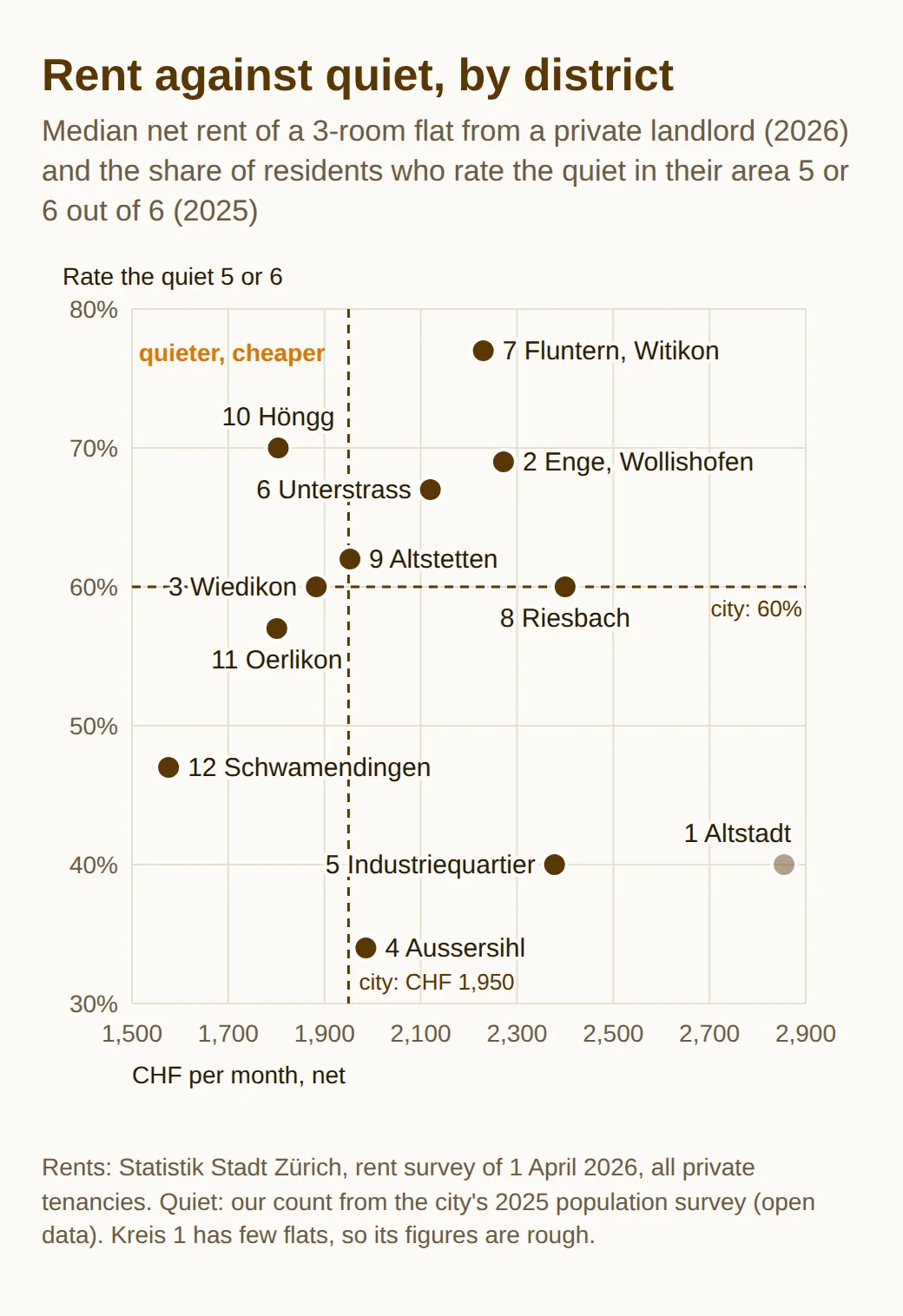
Kreis 10 stands out: the third-cheapest rent in the table, and 70% of residents rate the quiet 5 or 6 out of 6, against 60% across the city. Only Kreis 7 does better, at 77%, with Kreis 2 and 6 close behind at 69% and 67%. At the other end sit Kreis 4 at 34% and Kreis 1 and 5 at 40%, the districts around the main station and the old town, which is the price of living where the city goes out at night. Kreis 12 is cheap but not quiet, at 47%.
Green space follows the same lines. In Kreis 7, 86% rate the parks and green areas near them 5 or 6, and in Kreis 2, which has the lakeshore, 85%. In Kreis 4 it's 43%. Within a district the spread can be wider still. The city's report by quarter found that 57% of residents of Fluntern give the quiet the top mark, against 7% in the Langstrasse quarter, and that 65% in Witikon give green space the top mark, against 8% in Werd, next to the main station.
Feeling safe at night varies less than the reputations suggest. Across the city, 85% of residents say they feel very or fairly safe out alone at night in their area. Kreis 6 is highest at 92%, and Kreis 12, 4 and 11 are lowest at 76%, 77% and 78%. That is a real gap, but three out of four still answer yes in the districts with the lowest scores. If quiet and green matter to you, you'll pay less for them in Kreis 10 and 6 than in Kreis 7 or 2. The next question is how far that puts you from work.
How long is the commute from each district?
From almost anywhere in the city, the main station is under 20 minutes away by public transport. We checked the timetable for a Tuesday morning from a main stop in each district. The districts on an S-Bahn line win, whatever their distance on the map: Hardbrücke in Kreis 5 is 3 minutes from Zürich HB, and Oerlikon, Altstetten and Enge are 5 minutes each.
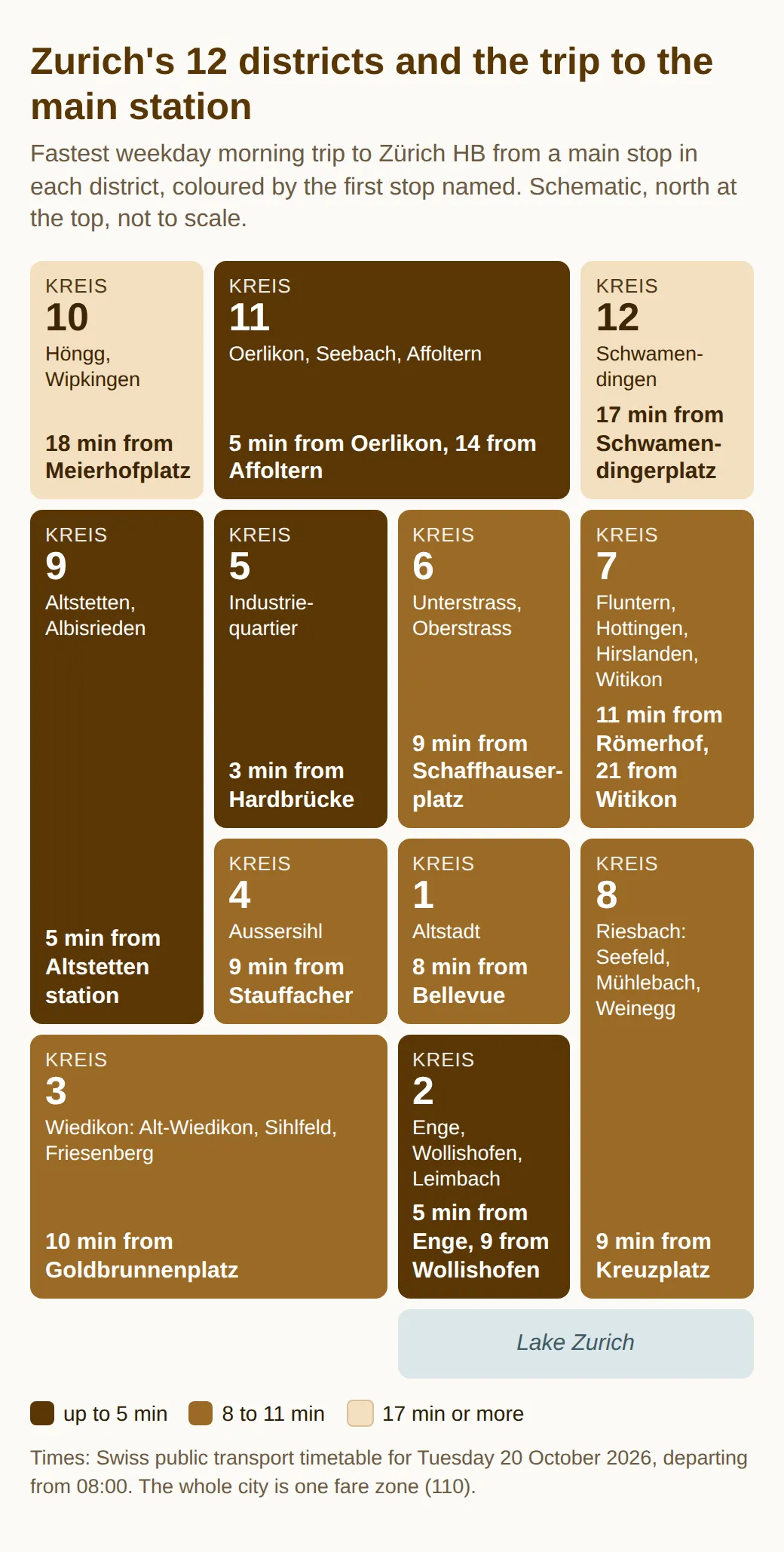
The slowest trips start from the districts that are only reached by tram or bus. Meierhofplatz in Höngg is 18 minutes from the main station, Schwamendingerplatz 17, and Witikon, at the top of Kreis 7, 21. That's the trade-off behind Kreis 10's good marks: Wipkingen has its own station, but Höngg itself is a tram or bus ride. Your workplace matters more than the main station, of course. If you'll work in Oerlikon or Altstetten, a flat a few stops further out on the same line can beat a central one.
Whatever you choose, the ticket is the same. Until 12 December 2026, the ZVV, the regional transport network, sells a personal pass for the city zone 110 at CHF 88 a month or CHF 813 a year for adults in second class. From 13 December 2026, ZVV fares rise by 2.1% on average for passes and single tickets. For families, though, the trip that matters most is the one to school.
Schools: your address decides
In Zurich, your child goes to the public school the city assigns to your address, so choosing a district largely means choosing a school. The city runs its schools in seven school districts, each with its own school board (Kreisschulbehörde). They map onto the Kreise roughly like this:
- Zürichberg: Kreis 1, 7 and 8
- Uto: Kreis 2 and most of Kreis 3 (Alt-Wiedikon, Friesenberg)
- Limmattal: Kreis 4 and 5, and Sihlfeld in Kreis 3
- Letzi: Kreis 9 (Albisrieden, Altstetten, Grünau)
- Waidberg: Kreis 6 and 10 (Unterstrass, Oberstrass, Wipkingen, Höngg)
- Glattal: Kreis 11
- Schwamendingen: Kreis 12
The assignment works by address, and the nearest school isn't always the one you get. The board weighs the length and safety of the walk to school and balances class sizes between buildings. Parents can ask for a different school, but the city states plainly that there is, as a rule, no choice.
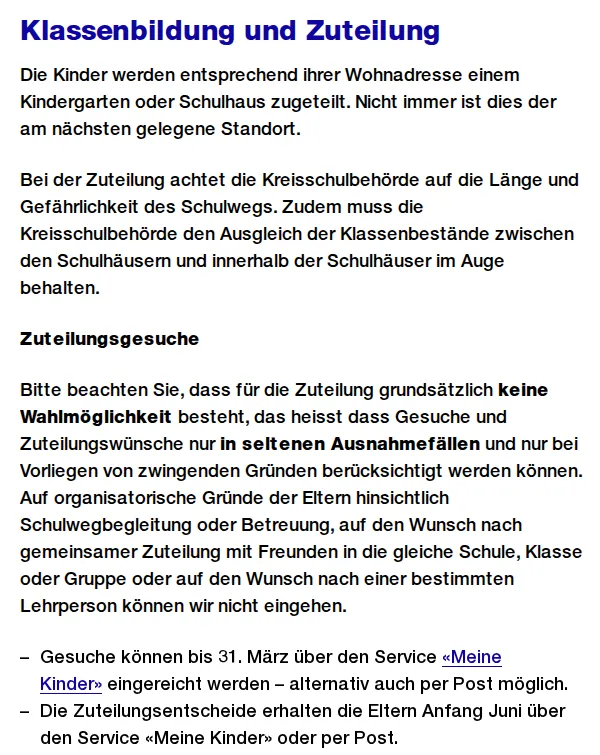
Requests go in by 31 March through the city's «Meine Kinder» service or by post, and parents hear in early June. So for a family, choosing a district comes before choosing a school, and the population figures say a lot about family life in each one. In Kreis 2, 16.3% of residents are under 15, the highest share in the city, followed by Kreis 12 at 14.6%, Kreis 11 at 13.9% and Kreis 9 at 13.8%. The city as a whole sits at 13.1%. In Kreis 4 it's 8.2%, and in the old town 6.2%. Where there are many children, yours will have more of them nearby to play with, and you'll meet other parents.
Who lives where
Each district has its own mix of people, and the register shows it plainly. In Kreis 4, 42% of residents are aged 25 to 39, and in Kreis 5 it's 37%, against 30% across the city. Kreis 7 is the opposite, with only 22% in that age group and the highest share aged 65 or over, 20.1% against 13.9% across the city. About a third of Zurich's residents, 33.9%, are foreign nationals. The share is lowest in Kreis 10 at 27% and highest in Kreis 11 at 39%, with Kreis 4, 8 and 12 at 38%. You won't be the only newcomer anywhere.
Who owns the buildings shapes a district as much as who lives in them. In Kreis 12, 43% of flats belonged to housing cooperatives in 2025, according to the city's housing stock data, against 17.9% across the city. Cooperative flats are not in the private-rent table above, and they cost far less: the city-wide median for three rooms is under CHF 1,100. In Kreis 7 and 8, the cooperative share is 3% and 2%, and nearly every flat belongs to a private owner. New building is concentrated too: 26% of the flats in Kreis 9 and 24% in Kreis 5 were built in 2010 or later, against 9% in Kreis 7 and 8. New flats are bright and have lifts and modern kitchens, and they also set the top rents. All of this adds up to a fairly clear choice, depending on what you want.
Which district fits you?
For the lake and a short walk to everything
Kreis 2 and 8 sit on either side of the lake. Enge and Wollishofen in Kreis 2 combine lakeside parks with an S-Bahn station 5 minutes from the main station, and the district has the highest share of children in the city. Riesbach in Kreis 8, with Seefeld, runs along the east bank, and it is the second most expensive district in the table. Expect to pay over CHF 2,200 for three rooms on either side, and more for a newly let flat.
For quiet, green and still in the city
Kreis 10, 6 and 7 all rate well above the city for quiet. Kreis 10 (Höngg and Wipkingen) is the best value of the three, and Wipkingen has its own S-Bahn station. Kreis 6 is closer to the centre, with trams to the main station in about 9 minutes. Kreis 7 runs up the Zürichberg from Hottingen to Witikon and is the quietest and greenest of all, at a higher rent and with longer bus and tram rides from the top.
For nightlife and a short trip to everything
Kreis 4 and 5 are where the city's younger residents live, around the Langstrasse and in the former industrial quarter of Zürich West. The main station is a few minutes away and the streets stay busy late. Residents there give the quiet and the green space the lowest marks in the city, so look at the side streets and ask about the bedroom side of the building at the viewing. Kreis 1, the old town, is similar: central and loud, with few flats and the highest rents.
For more space for the money
Kreis 9, 11, 3 and 12 give you the most flat per franc. Altstetten in Kreis 9 and Oerlikon in Kreis 11 are both 5 minutes from the main station by S-Bahn, both have plenty of new buildings, and both rate close to the city average for quiet. Wiedikon in Kreis 3 is a short tram ride from the centre for slightly less than the city median. Kreis 12 is the cheapest of all, with a large share of cooperative flats, at the cost of a 17-minute trip to the main station and lower marks for quiet.
Search more than one district
With empty flats this scarce everywhere, the best district is often the one where you get a contract. Pick two or three that fit your budget and your commute rather than one, and learn their quarters by name and postcode so you can judge a listing in seconds.
Use the table above to set a realistic budget for each district, adding about 15% for a newly let flat and the service charges on top. Then go to viewings in all your districts, not only your favourite: a flat in Kreis 10 you can actually get beats a flat in Kreis 7 that dozens of other people want. Our step-by-step guide covers the application file and the debt-collection extract that landlords will ask for.
Common questions
What is the difference between a Kreis and a quarter?
A Kreis is one of the 12 districts the city is divided into, numbered 1 to 12. Each Kreis is split into quarters, 34 in all, and the quarters often feel more different from each other than the districts do. Listings usually give the postcode or the quarter, so learn the names of the quarters you like, not only the numbers.
Which district has the most empty flats?
None has many. On 1 June 2026 Kreis 11 had the most empty flats in number, 58, and Kreis 6 the highest share, 0.15 percent. Kreis 5 had the lowest share at 0.05 percent. The gap between districts is too small to change your strategy, so search wherever your budget works.
Is Kreis 4 safe at night?
Most residents there say so, but fewer than elsewhere. In the city's 2025 survey, 77 percent of Kreis 4 residents said they feel very or fairly safe out alone at night in their area, against 85 percent across the city and 92 percent in Kreis 6. The noise is the bigger complaint: only about a third rate the quiet well.
Do I need a different public transport ticket for each district?
No. The whole city is one fare zone, 110, so one pass covers every tram, bus and S-Bahn trip inside the city. Until 12 December 2026, the ZVV lists a personal pass for the city at CHF 88 a month or CHF 813 a year for adults in second class. ZVV fares rise on 13 December 2026, by 2.1 percent on average for passes.
More from the blog
All posts
Internet provider for your Zurich apartment: 2026 checklist
Before you choose an internet provider for a Zurich apartment: check fibre and cable at the address, find the socket ID, know the notice rules, order in time.
Quiet apartment in Zurich? Check the noise maps first
Is that Zurich flat quiet? Read the city's noise map spot by spot, the airport's runway hours and the legal limits, and know your rights if it gets louder.
Buy or rent in Zurich? The 2026 numbers for one flat
Buy or rent in Zurich in 2026: city prices against rents, the equity and one-third income rules, the 2029 end of imputed rent tax and one flat worked through.