How to find an apartment in Zurich: the 2026 guide
The short answer
Apply fast, with a complete file, to many flats at once. On 1 June 2026 only 252 of the city of Zurich's roughly 238,000 flats stood empty, about 1 in 950. Most flats change hands without ever being empty, so you are competing at viewings. Order your debt-collection extract the day you register, and never pay before you have seen a flat.
That is the whole strategy. The rest of this guide is the detail that makes it work, and each figure in it links to whoever published it.
What 0.11 percent means for your search
The vacancy rate is the share of all flats standing empty on one day a year, and in the city of Zurich it was 0.11% on 1 June 2026. Statistik Stadt Zürich counted 252 empty flats, 17 more than in 2025. Of those, 246 were for rent and 6 for sale. Across Switzerland the rate was 0.93% on the same day, and in the canton of Zurich 0.52%. The canton's rate is almost five times the city's.
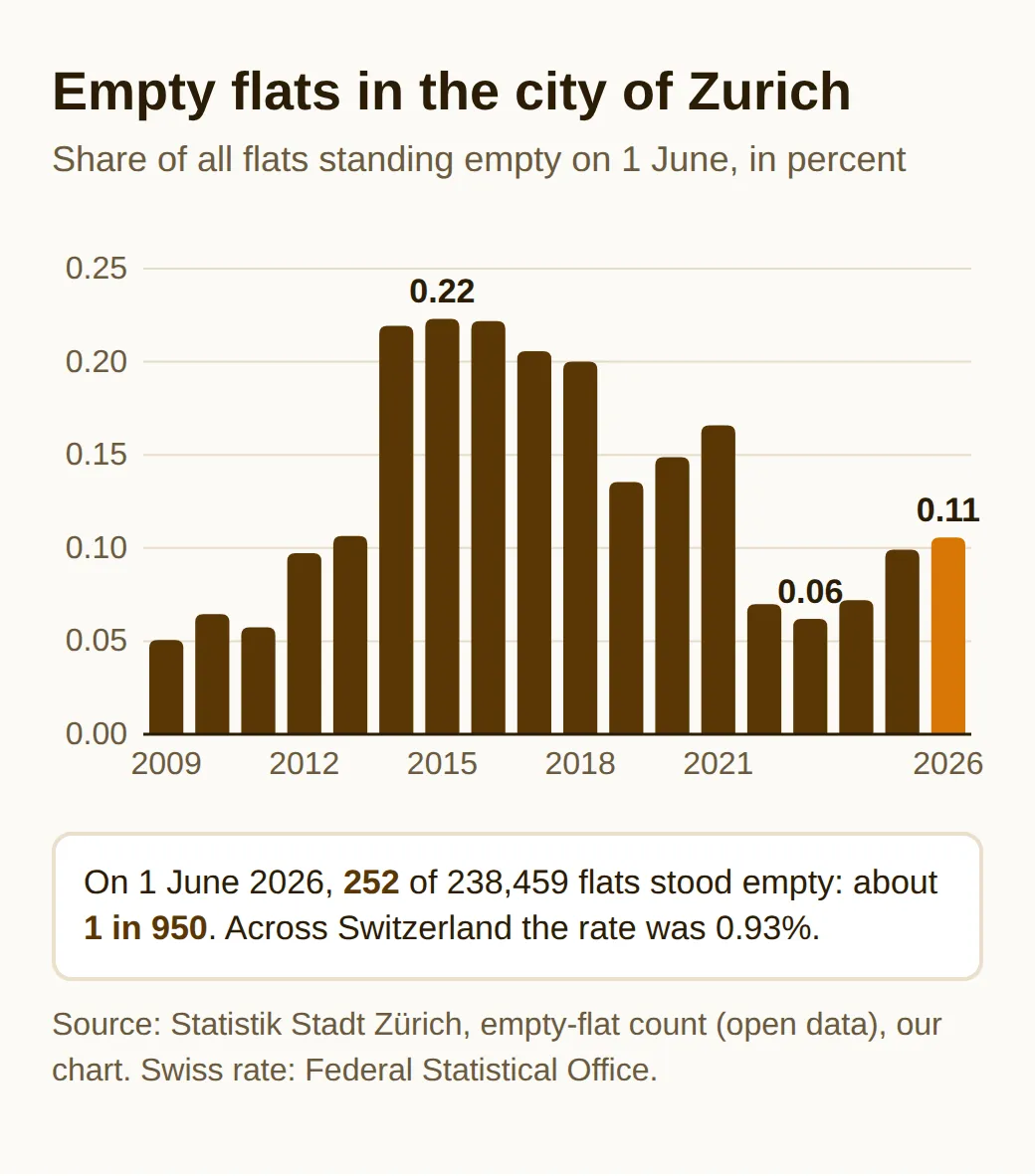
Read that number carefully, because it doesn't mean only 252 flats are available. The count only includes flats that are empty on 1 June and offered for at least three months, and flats already let for a later date are left out. The city's statisticians put the real flow next to it: around 2,000 flats are offered on the Zurich market every month, and most are let again straight after the previous tenant moves out.
So flats do come up, in a steady stream. What's missing is slack: with almost nothing standing empty, nearly every flat goes from one tenant straight to the next. Your job is to be at the viewing early, with everything ready to hand over that evening. The good news is that the trend has turned slightly in your favour: the city's open data shows the count rising for three years in a row, from 144 in 2023. The city points to slower population growth and more new flats being finished. New flats are also the most expensive, which brings us to rent.
What you will actually pay
The median rent you read about is not the rent you will be offered. Statistik Stadt Zürich's 2026 rent survey puts a typical 75 m² flat at about CHF 1,700 a month in net rent, but that includes tenants who signed 20 years ago. When a flat changes hands, the rent usually jumps. Here is the same 75 m² flat by type of contract, net rent per month, surveyed on 1 April 2026:
| Type of contract | Median net rent, 75 m² |
|---|---|
| Private landlord, new building | CHF 2,907 |
| Private landlord, new tenant in an older building | CHF 2,287 |
| Private landlord, tenant for more than 10 years | CHF 1,657 |
| Non-profit landlord, all tenancies | CHF 1,149 |
Net rent excludes service charges such as heating and hot water, and the city notes that gross rents run 10 to 15% higher. As a newcomer you are almost always in the first two rows. Budget for a newly let 75 m² flat from a private landlord at roughly CHF 2,300 net, so somewhere around CHF 2,500 to 2,650 with charges, and adjust for size. The last row explains why non-profit flats are so sought after, which we come to below.
Where to look, and why speed matters
Many flats are let by property management companies (in German, Verwaltung) and advertised online, and speed matters more than reach. The University of Zurich's housing advice notes that applications are often dealt with in the order they come in, so seeing a flat on the day it goes up is worth more than seeing ten flats a week late. Set up alerts for the districts and the budget you can live with, and check them at least twice a day.
Beyond the listings, ask your employer whether it works with a relocation service or has a housing contact, tell colleagues you're looking, and if you study or work at the University of Zurich, check its own housing ads. The same university page points out that districts 1, 2 and 8 (centre and lakeside) and the university area of district 6 and parts of 7 tend to cost more, and that living outside the city is usually cheaper, with public transport making the commute easy. That last point is worth taking seriously, given how much looser the canton is than the city.
Whatever channel brings you to a flat, the deciding moment comes after the viewing, when the landlord reads your application.
The application file, built in two rounds
A landlord may ask for everything needed to judge if you can pay the rent, but not all of it at once. The Federal Data Protection and Information Commissioner (EDÖB) sets this out in its leaflet on rental application forms, updated in July 2025. It describes a two-step process: everyone fills in a standard form, then the landlord picks one or a few candidates and asks only them for proof.
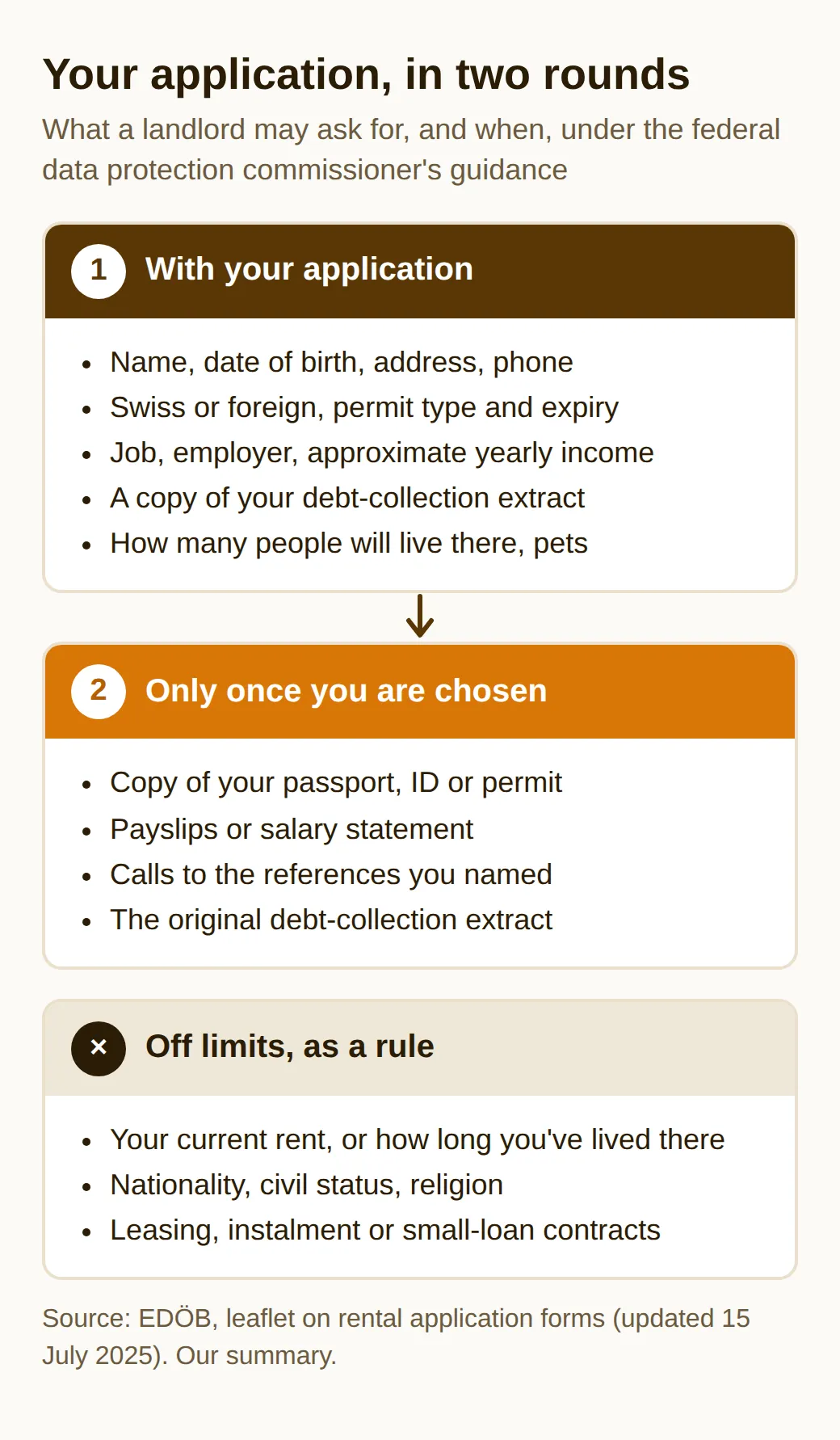
In the first round, a landlord may ask for your identity and contact details, your job and employer, your approximate yearly income (in brackets, the leaflet suggests), if you are Swiss or foreign, your permit type and when it expires, and how many people will live in the flat. A copy of your debt-collection extract may be requested from everyone who applies. Copies of your ID or permit and payslips are a second-round matter, for the person the landlord has chosen. References may only be called once you're seriously in the running, and only the ones you listed.
Some questions are off limits as a rule: your current rent and how long you've lived in your present flat (a 2003 ruling of the federal data protection commission confirmed that), your nationality beyond Swiss or foreign, your civil status, your religion, and any leasing or small-loan contracts. Once a contract is signed, the landlord must destroy the files of everyone who wasn't chosen.
In practice, some landlords ask for ID and proof of income with the application anyway, the city among them, and you'll have to decide if you go along with it. Knowing the rule helps in two ways. You can leave out what isn't needed without looking careless, and you can spot a fake: a "landlord" who wants your passport and three payslips before you have even seen the flat is behaving like the scammers described below, not like a property manager.
How to order the debt-collection extract
The document most Zurich application forms ask for is the Betreibungsregisterauszug, an extract from the debt-collection register. It shows whether anyone has started debt-collection proceedings against you at your address in the last five years. In the city of Zurich, you order it online, by post or at the counter of the office for your district. There are twelve district offices, and the online form finds the right one for you. Online, you upload a photo or scan of an official ID. At the counter you bring the ID, and you can pay only in cash or by debit card.
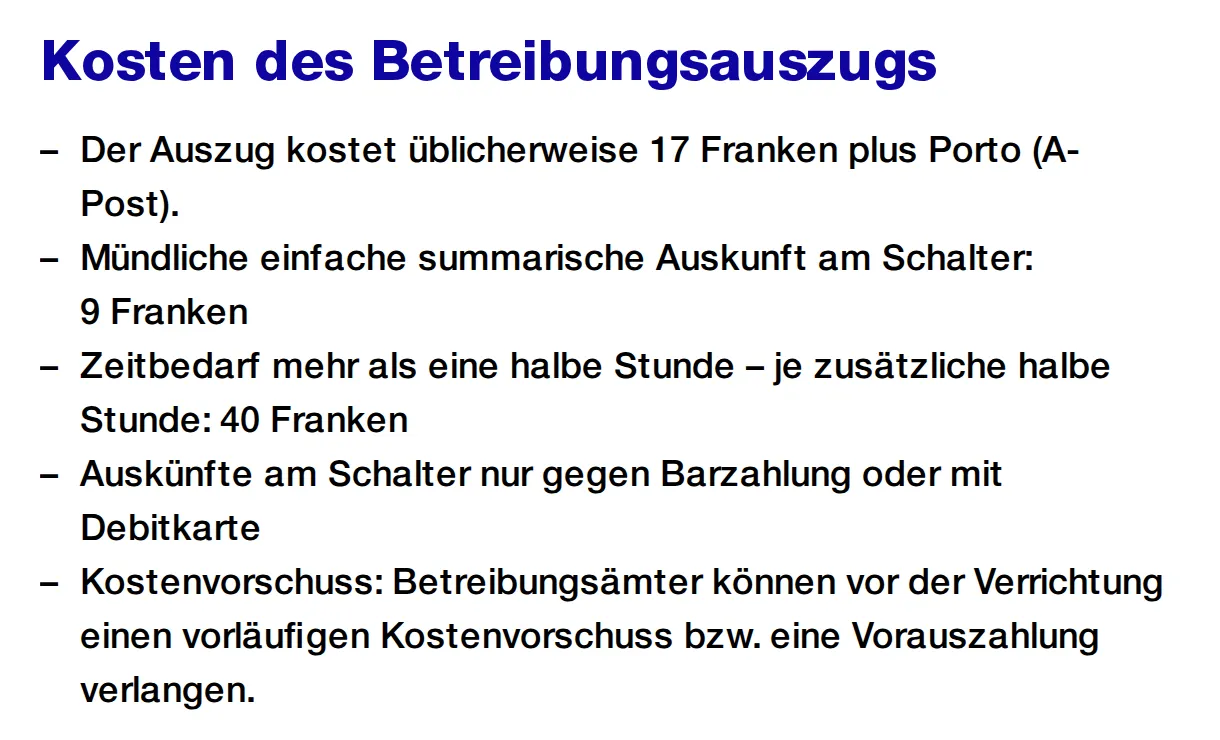
Two details catch newcomers out. The extract only comes in German, and written extracts are sent only to Swiss addresses. If you have just arrived, the office still issues one: when you have lived somewhere only briefly, the extract states how long, and if you never lived at the address, it says so. That's expected for a newcomer. Order it the day you register your address, and keep a scan on your phone so you can attach it to an application within minutes of a viewing. The city asks for an extract no older than six months for its own flats, and a recent one is the safe choice for any landlord.
If you have never lived in Switzerland and have no address here yet, the University of Zurich suggests explaining in your application why you can't provide an extract, and notes that applicants who lived in Germany can offer a SCHUFA credit report instead. A short note in your application is enough:
I moved to Zurich on 1 October 2026 to start work at [employer]. My debt-collection extract for my new address is attached and shows my arrival date. Before that I lived in [country], where I had no debts in collection. My employment contract and my bank's confirmation are available on request.
How do landlords choose?
There is no legal formula. Landlords pick the tenant they think will pay reliably and cause no trouble, and in a market this tight they can afford to be choosy. What counts in practice is visible in the form itself: income that comfortably covers the rent, a clean extract, a permit that runs long enough, a household that fits the flat, and a complete application that arrives early. Application forms are often handed out only at the viewing, the University of Zurich notes, so the people who turned up are the ones being compared.
So treat the viewing as the start of the application. Arrive on time, bring a printed or digital copy of your extract, and check the flat against the listing while you're there (pets, instruments, washing machine rules). Fill in the form completely the same day, even if the German is a struggle, and add a few lines about who you are and why the flat suits you. If something is missing, say why rather than leaving a gap. An incomplete form is the easiest one to put at the bottom of the pile.
Not every landlord is private, though, and two large groups choose by very different rules.
City flats and cooperatives: cheaper, with rules
The city of Zurich owns about 10,000 flats, around 5% of all housing in the city, and lets them by fixed rules. Free flats appear on the city's own rental platform, reached through its "Mein Konto" portal. Viewing places are drawn by lot, and only people who viewed the flat, themselves or through someone who gave their name on site, can apply. The city usually decides within two to three weeks of the deadline. If you have lived in Switzerland for less than a year, it asks for your three most recent payslips instead of a tax assessment.
The conditions shut many newcomers out, and it's better to know before you enter the lottery. A flat needs at least as many people as rooms minus one, so three people for a 4-room flat. Your household's taxable income may be at most four times the gross yearly rent: for a flat at CHF 1,500 a month with charges, that is a ceiling of CHF 72,000 a year. You must register your residence in Zurich by the start of the lease. Subsidised city flats add more: two years living in the canton before the lease starts, Swiss citizenship or a B, C or S permit, and taxable assets of no more than CHF 200,000.
Housing cooperatives (Genossenschaften) are the other big group of non-profit landlords, and the rent table above shows why they're so sought after. There is no central list: each cooperative lets its own flats under its own rules, including what you pay in as a member, so read those rules on its website before you apply. For a newcomer in the first months they're rarely the route to a first flat, but it costs little to follow a few cooperatives in the districts you like while you rent privately.
Whichever landlord says yes, two things happen next: you pay a deposit and you receive a form about your rent.
The deposit and the initial rent form
The law caps a deposit at three months' rent. Under Article 257e of the Code of Obligations, the landlord must place it with a bank in a savings account in your name, and the bank may release it only if you both agree, or on a final court ruling or a final payment order. If the landlord makes no legal claim within a year after you move out, you can ask the bank for it yourself. A landlord who wants the deposit paid into their own account, and kept there, is breaking that rule.
If three months' rent is hard to find at once, some landlords accept a deposit insurance instead. The tenants' association is blunt about it: premiums are usually around 5% of the insured sum a year, nothing is refunded, and if the insurer pays the landlord, it then claims that money back from you. Over a few years that adds up to a real cost for no real protection, so treat it as a last resort.
The second piece of paper is easy to overlook. In the canton of Zurich, a landlord letting a flat on a new lease must tell you the previous tenant's rent on an official cantonal form, a rule in force since 1 November 2013. If your rent is much higher than the previous one, or the tight market pushed you into signing, you can challenge the initial rent at the conciliation authority within 30 days of moving in. The Zurich courts treat a rise of 10% or more over the previous rent as significant, and a housing shortage alone counts as market pressure. You still have to show that the rent is abusive, which is the hard part, but a large jump over the previous rent can make the court presume it is, and the landlord then has to justify it. Read the form when it arrives, and keep it.
When should you start looking?
Start looking about two to three months before you need to move in, and have somewhere temporary for the first weeks. Tenants in Switzerland must give at least three months' notice, so many flats are advertised while the old tenant still lives there, for a start date weeks or months away. Where a lease sets no dates of its own, local custom decides, and in the city of Zurich, the tenants' association notes, that means only two dates a year. But more and more leases now allow notice for the end of any month, which spreads flats more evenly across the year.
Searching from abroad works for scouting, but you need someone at the viewing to get the form. The University of Zurich advises having a temporary place to stay for your first days or weeks. A furnished studio or a room in a shared flat is the usual bridge, and a furnished room has a short exit: two weeks' notice to the end of a one-month period.
Living in the city while you search also gives you a Swiss address, which means a debt-collection extract, and you can get to a viewing at short notice.
Scams that target newcomers in Zurich
The scams follow a pattern, and the police platform cybercrimepolice.ch documents it case by case. A classic version is a flat that looks too good for its price, an owner who is "abroad for work" and can't show it, a request for a copy of your ID, and then a deposit to "reserve" the flat through a money transfer service. The money is gone the moment you send it.
A newer version, reported in April 2026, goes after your data rather than your money. Attractive flats are posted on real Swiss property portals. Applicants are then contacted on WhatsApp by someone posing as a real agency and sent to a fake online application form that asks for a complete file: personal and contact details, ID copies, employment contract, payslips, sometimes financial data. Everything you upload can be used for phishing or for contracts in your name.
The checks that stop both are simple. Never pay anything before you've seen the flat and hold a contract. Don't send ID copies or payslips to someone you haven't met, which matches what a real landlord may ask for in the first round anyway. Call the property management on a number you found yourself rather than one in the message. Run a reverse image search on the photos, and check that the address exists. If you've already sent ID copies, the police advise applying for new documents so the old ones become invalid, and reporting the case.
Your first week, in order
If you've just arrived, this is the sequence that gets you to a lease fastest. Register your address, then order your debt-collection extract online the same day, and scan it as soon as it comes. Write a one-page profile in English or German with who lives with you, your job and start date, your permit and your income, and keep it as a PDF next to the extract. Set up alerts for the districts and budget you can live with, and widen the area by one train stop more than feels comfortable.
Book every viewing you can reach, apply the same evening, and keep a list of where you applied so you can follow up after a week. Hold back ID copies and payslips until a landlord has picked you, unless you've met them and are sure they are who they say. When the lease and the initial rent form arrive, check the deposit goes into an account in your name, and note the date: you have 30 days from moving in if the rent looks out of line with the previous tenant's.
Common questions
Can I rent a flat in Zurich before I arrive in Switzerland?
It happens, but it is hard. The application form is often handed out only at the viewing, and the city only accepts applications from people who viewed its flats, either themselves or through someone who gave their name on site. A friend or colleague who can attend viewings for you is worth more than any number of emails.
Is a room in a shared flat a sensible first step?
Often, yes. A furnished room can be ended with two weeks' notice to the end of a one-month period, so it does not tie you down while you look for a flat. Not every room is let as a furnished room, though, so check the notice period in the contract before you sign.
What if my debt-collection extract shows an entry?
A landlord may ask about pending debt-collection cases and loss certificates from the last five years, nothing older. If an entry is already paid or was unjustified, add a short explanation and proof to your application rather than hoping nobody reads it.
Why is the vacancy rate so low when I see hundreds of listings?
The count only includes flats that are empty on 1 June and offered for at least three months. A flat that is advertised while the old tenant still lives there, or that is already let for a later date, does not count. So the listings you see are mostly flats changing hands, not flats standing empty.