Quiet apartment in Zurich? Check the noise maps first

Check in this order
You can find out before you sign. Look the building up on the city's road noise map, which rates every side of every building for day and night, and check which side the bedroom faces. Then read the airport's runway hours for your area and go back once at 06:15 and once after 22:00. If a noise gets worse later, you can ask for a rent cut.
Most advice on finding a quiet apartment in Zurich stops at district names. A district tells you less than you'd think. On one corner of Rosengartenstrasse, the city's own data puts two spots on the walls of the same building 27 decibels apart at night. The district ranking in our guide to the best neighbourhoods shows what residents say; this guide shows what the official maps say about one address, what the numbers mean, and what the law gives you when a known noise gets worse.
Which noise map covers your address?
It depends on the source of the noise and on where the flat is. Inside the city of Zurich, road noise is in the city's own cadastre; the rest of the canton has had its own building-by-building maps since September 2026; railways and the airport each have separate maps. The law says anyone may inspect a noise cadastre (LSV art. 37).
| Noise source | Where to look | What it shows |
|---|---|---|
| Roads in the city of Zurich | City road noise cadastre, as open data and in a 3D viewer | A day and a night level for points all round each building |
| Roads elsewhere in the canton | The canton's GIS browser | The highest level per building, today and in future |
| Railways | Federal Office of Transport noise cadastre | Day and night levels, based on 2021 traffic |
| Aircraft | The canton's aircraft noise maps | Levels around Zurich Airport |
The city's road data is the most detailed of the lot. Its current version describes the situation in 2024 and was last updated on 29 January 2026, and it also models how each spot will sound once the city's planned speed limits and quieter road surfaces are in place. For a quick national overview, the Federal Office for the Environment's sonBASE maps cover road and rail noise across Switzerland, by day and by night.
Every one of these maps speaks in the same unit and against the same limits, so it pays to learn how to read them once.
What the decibel figures mean
The number on a noise map is a rating level, written Lr, in dB(A). It is a yearly average, calculated separately for the day (06:00 to 22:00) and the night (22:00 to 06:00), and it is worked out for the middle of an open window (LSV art. 39). It is not the peak you hear when a lorry passes. A single truck at 3 am disappears into the average, which matters for light sleepers.
What counts as too loud depends on the zone the building stands in. The ordinance gives every zone a sensitivity level (art. 43): level II for purely residential zones, level III for mixed zones of homes and businesses. The city's data tells you which level applies at each spot. For each level, Annex 3 sets three limits:
- the planning value, the strict target for new building zones;
- the impact limit (Immissionsgrenzwert), above which noise counts as excessive;
- the alarm value, the line for the worst cases: where a public road is allowed to stay above it, building owners must have the windows of the rooms people live and sleep in sound-insulated, at the road owner's cost (art. 15 and 16).
At night in a residential zone, those limits are 45, 50 and 65 dB(A). In a mixed zone they are 50, 55 and 65. In Zurich, about 125,000 people live in a building where road noise is above the legal limits, according to the city's 2026 environment report, and the share is higher at night than by day, because the night limits are stricter.
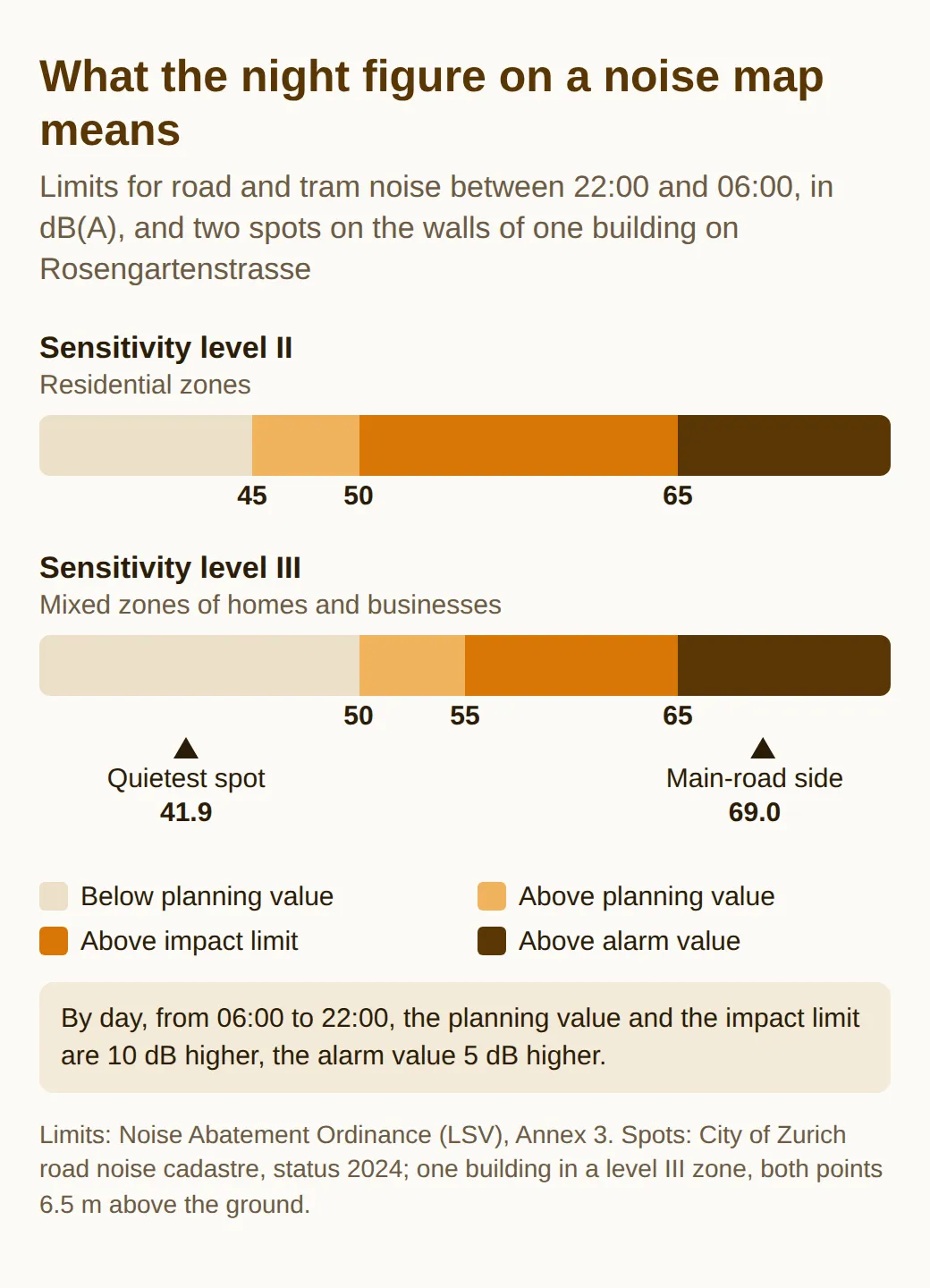
The scale is logarithmic, so small numbers mean a lot. The Cercle Bruit, the association of the cantons' noise specialists, gives a simple example: two motorbikes at 80 dB together make 83 dB. By the same sum, twice the traffic adds about 3 dB, and half the traffic takes about 3 dB away. That is also the gain the city expects from lowering the speed limit from 50 to 30 km/h. So when two flats differ by 10 dB or more, you are not comparing shades of the same thing. You are comparing a different night's sleep, which is exactly what happens on the corner below.
One building, two sides
On the city's road noise map, the side of the building a bedroom faces often matters more than the district. We pulled the data for a corner building in Kreis 10 where Rosengartenstrasse, a main road, meets a side street. According to the federal building register, it was built in 1928 and has six flats. The city's cadastre rates 81 spots on its walls.
At night, those spots range from 41.9 to 70.7 dB(A). Compare two of them at the same height, 6.5 metres above the ground and 23 metres apart: the spot facing the main road reads 69.0, the quietest spot on the building reads 41.9. The building is in a mixed zone, so the first is above the alarm value of 65, and the second is below even the planning value of 50. Same building, very different nights.
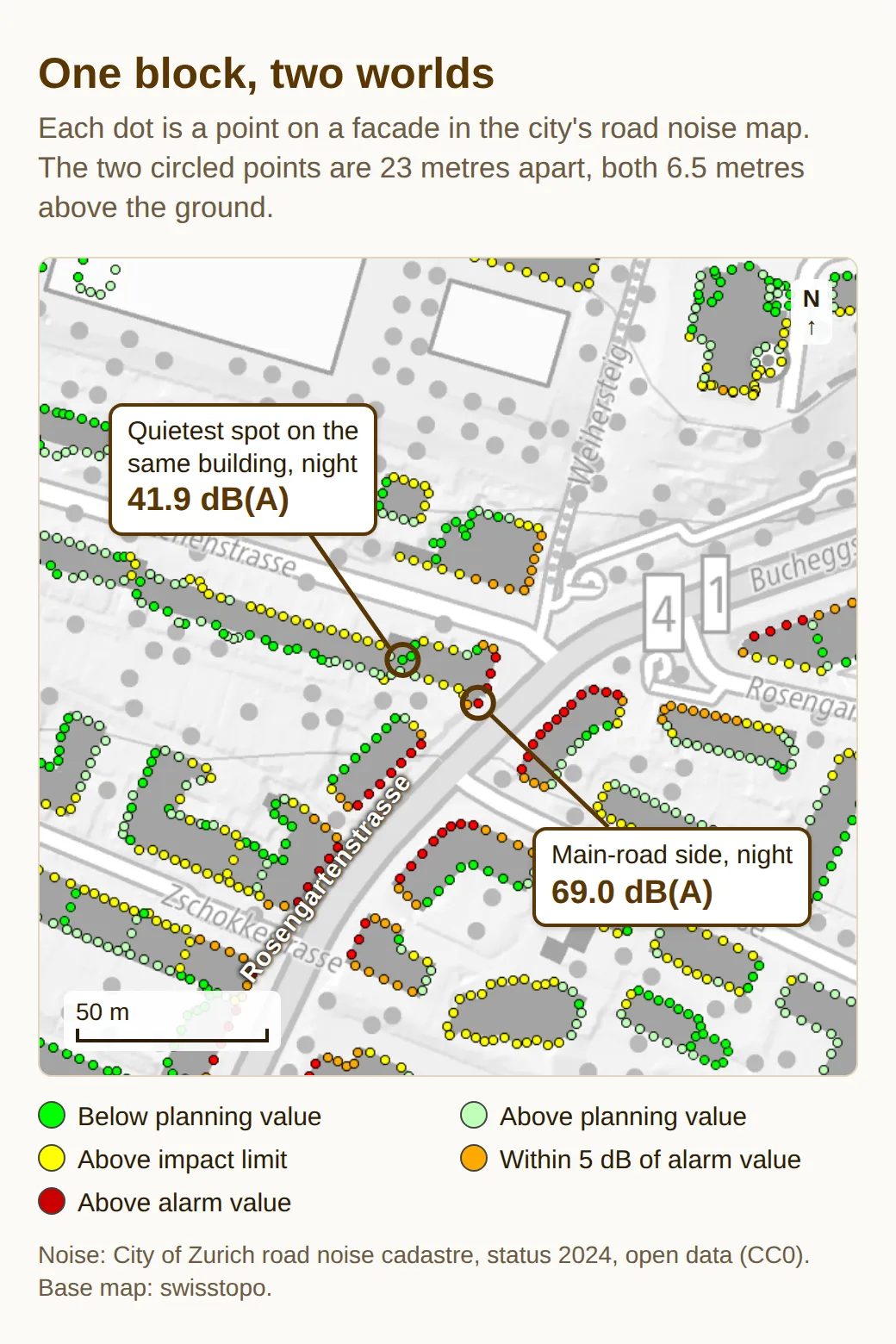
Height cuts both ways. On the side facing the main road, the spots got slightly quieter higher up, from 70.7 near the ground to 67.1 at 11.5 metres. On the other side, it went the other way: one column of spots rose from 44.5 at 4 metres to 52.1 at the top. So a top-floor flat is not automatically the quiet one.
To check a flat yourself, open the city's 3D viewer, find the building, and look at the spots on the side where the bedroom is. The open data lets you go further: it includes a scenario for 2035 with the speed limits the city council has decided, mostly 30 km/h, and one for 2045 with quieter road surfaces, which the city plans to lay on about 200 km of streets. Those scenarios show how much each spot is expected to gain. Read the 2035 one with care on a main road: since 1 June 2026, cantonal rules make 30 km/h on larger roads harder to introduce, the city's environment report notes. The cadastre has one blind spot, though, and in Zurich it is a big one: trams.
Trams: the noise the road map can leave out
The city's road noise data counts trams only where they share the road with cars. Trams on their own separate track are not included, the dataset's description says. The Cercle Bruit explains why: a tram on a track physically separated from the road is treated as a railway, not as road traffic. On a stretch like that, the road map can look calmer than the street really is.
Trams also make a noise that averages hide. On a straight track, you mostly hear the wheels rolling. In curves, the Cercle Bruit notes, it is the high-pitched squeal that people notice most. If the flat overlooks a tight curve or a turning loop, wait at the open bedroom window until a tram takes it.
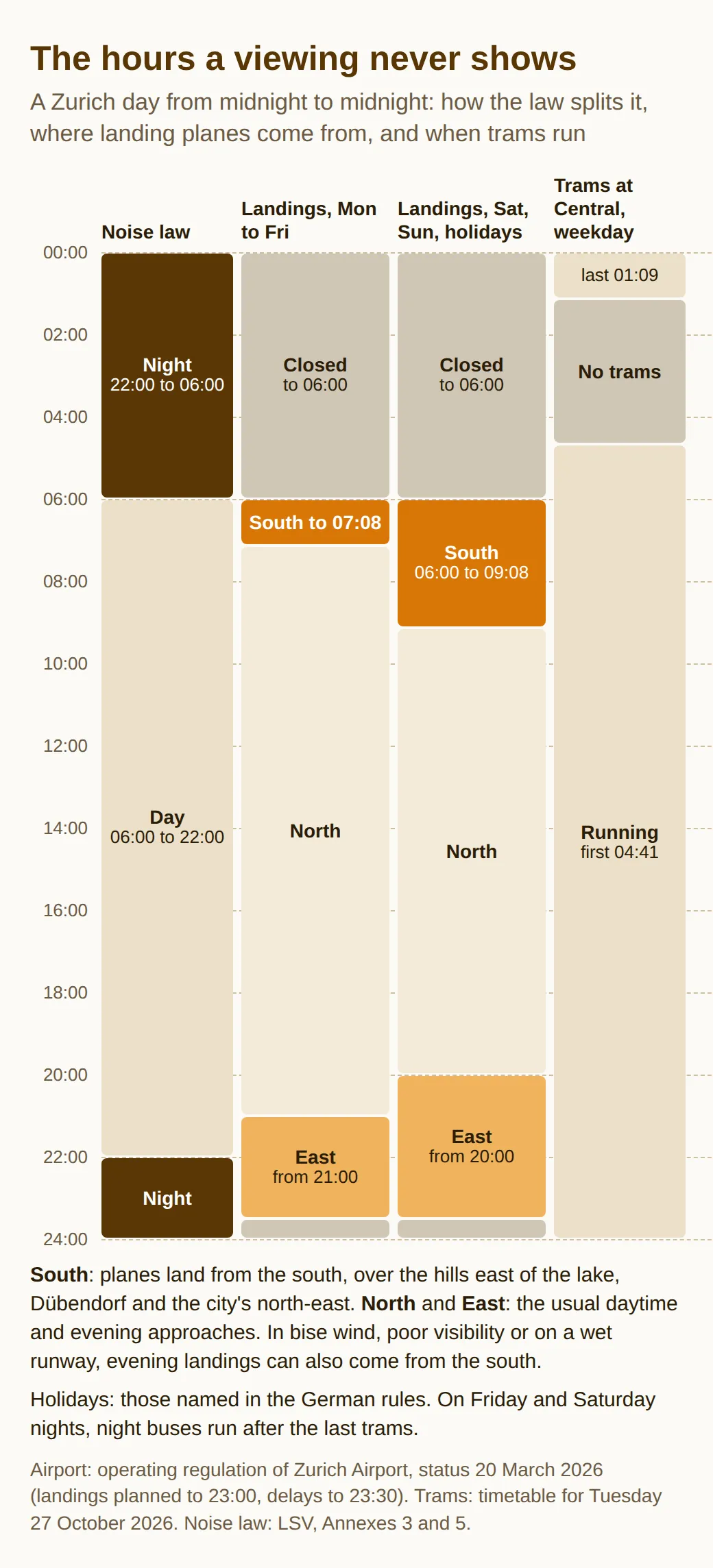
Then there are the hours. On a weekday in late October 2026, the timetable at Central shows the last tram leaving at 01:09 and the first at 04:41. The legal night starts at 22:00, so trams run for about four and a half of its eight hours. On Friday and Saturday nights, night buses take over, and many leave the main station every 30 minutes between 01:15 and 04:15. Mainline trains are a different story again.
Railways: quieter gaps, louder nights
For railway lines, use the Federal Office of Transport's cadastre, which you can view on the federal map site. It shows day and night levels at buildings near the tracks, with noise barriers already counted in. The current figures for actual noise are based on 2021 traffic, and an update with 2025 traffic is planned.
Rail noise is felt differently from road noise. The Cercle Bruit says people often find it less disturbing, because the quiet gaps between trains are longer, with braking as the exception. Nationally, rail touches far fewer people than roads: in 2021, 33,000 people in Switzerland lived with harmful or annoying rail noise, against 740,000 for road traffic, according to the Federal Office for the Environment. The same office notes that rail and aircraft noise affect people mainly at night. Which brings us to the one noise source in Zurich that keeps a strict timetable.
Aircraft: the 6 am approach the maps barely count
Zurich Airport opens at 06:00, and on weekdays its first landings usually come in from the south until 07:08. On Saturdays, Sundays and the public holidays named in the German rules, that south approach runs until 09:08. The operating regulation (status 20 March 2026) sets these hours because Germany restricts approaches over southern Germany at those times. During the day, landings normally come from the north. From 21:00, and from 20:00 at weekends, they come from the east. Commercial flights may be planned until 23:00, and delayed ones may land or take off until 23:30 without special permission.
The numbers are not small. In 2024, about 7,900 morning landings came in from the south, and another 2,900 in the evening, when wind, poor visibility or a wet runway ruled out the eastern approach, according to the canton's airport report 2025. Between 23:00 and 23:30, there were 2,983 movements of large aircraft, and 385 more had an individual permit to fly after 23:30.
Here is the catch for flat hunters: the legal noise maps hardly register the morning approaches. For airports, the ordinance sets night limits only for the hours 22:00 to midnight and 05:00 to 06:00 (Annex 5). The hour from 06:00 to 07:00 is daytime, averaged over sixteen hours. The airport's own protection scheme for the south approach says plainly that these morning landings exceed no legal limit. It still fits bedrooms in a set area with automatic window closers or sound-insulated ventilators, because landings between 6 and 7 can wake people. That area includes the city of Zurich, where the work starts in Zürich Nord and Schwamendingen.
So a flat can look fine on the aircraft noise map and still sit under the morning approach. The scheme's perimeter plans, one per municipality, show whether a building is inside, and the owner will know if the bedrooms were fitted. The canton's own index counted 23,512 people around the airport as highly sleep-disturbed by aircraft noise in 2024. None of this shows up at a viewing on a weekday evening.
What a viewing at the wrong hour misses
A viewing on a Tuesday at 18:00 tells you about the traffic on a Tuesday at 18:00. It doesn't tell you about the 06:00 landings, the last trams after midnight, a Friday crowd leaving a bar, or a summer night with the windows open.
Season matters as well. The city receives more than 1,000 noise complaints a month in summer, against 200 to 600 a month in winter, its environment report says. In November you see a flat with the windows shut. The law, remember, measures at the open window.
So plan two short return visits before you sign, and stand in the bedroom with the window open each time:
- A weekday at about 06:15, or before 09:00 on a Saturday if the flat lies under the south approach.
- An evening after 22:00, ideally a Friday after midnight if there are bars or a night bus stop nearby.
If you can't go back yourself, ask the current tenant. They have heard every one of those hours.
Questions to ask before you sign
The map and the visits tell you what you'll hear. A few questions to the property manager tell you what can change. Ask them in writing, so you have the answers on record:
- Which rooms face the road or the tracks, and which side is the bedroom on?
- When were the windows last replaced, and are they sound-insulating?
- Is any building work or road work planned next door or in the street?
- Did the building take part in the airport's sound insulation programme or its south approach protection scheme?
- Is there a bar, a restaurant terrace or a delivery yard right below?
Write down what you heard at each visit, with the date and the time, and keep it with the lease. If the noise grows later, that note shows what you knew when you signed, which can matter when you ask for a rent cut.
If a known noise gets worse after you move in
You can ask for a lower rent from the day the landlord knows about it, even when the landlord is not to blame. The landlord must keep the flat fit for the use agreed in the lease (Code of Obligations, art. 256). If a defect arises or your use of the flat is disturbed during the tenancy, you can ask for the defect to be removed, for a lower rent and for damages (art. 259a). The reduction runs from the moment the landlord learns of the problem until it ends (art. 259d). The Zurich courts' guide to rent reductions adds that fault doesn't matter: noise the landlord cannot control counts too.
The yardstick is the flat you agreed to rent. Our reading of these articles: the tram you heard at the viewing is part of what you rented; a building site that opens next door a year later is not. Whether a given noise is enough is decided case by case, and the courts' guide lists real Zurich cases as a reference:
- Eight months of construction in the backyard next to a 4-room flat, audible with the windows shut, balcony unusable: one twelfth off the rent (Zurich tenancy court, 1996).
- Two months of pile driving in the same case, felt and heard with the windows shut: one third off.
- A railway station next door covered with a concrete slab and built over with homes and shops, plus road works outside: 16% off (Zurich tenancy court, 1999).
The tenants' association says that scaffolding on the facade alone can justify 10 to 15% off, and that cuts of up to 50% have been granted in single cases of building work nearby.
How you ask matters. Write to the landlord, ideally by registered post. The courts' guide, citing the Federal Supreme Court (BGE 142 III 557), says it is enough to make clear that the defect bothers you, but asking explicitly for a reduction leaves no doubt. Keep a noise diary with dates, times and photos. Never cut the rent on your own, the tenants' association warns: keep paying in full and claim the reduction. According to the courts' guide, the claim lapses only after five years, so you can still ask for money back later. A short letter is enough:
Since 3 March, building work on the plot next to our house has been running from 7:00 to 17:00 on weekdays, and the noise is clearly audible in all rooms with the windows shut. Our balcony cannot be used. We ask you to reduce the rent appropriately from 3 March until the work ends, and we are keeping a record of the disturbance.
If the landlord refuses, the conciliation authority is free and is the next step. Our guide to tenant rights in Zurich explains how it works and the deadlines that apply.
Shortlist by map, then by ear
A quiet flat in Zurich is usually a matter of which side of the building it faces, not which district it is in. So run every shortlisted address through the city's noise map first, and go to the viewing knowing which rooms face the loud side. Keep your two return visits for the flats that pass, and put your questions in writing before you sign. Our guide to finding an apartment in Zurich covers the application file you'll need once a flat passes the noise check.
Common questions
Do sound-insulating windows change what the noise map shows?
No. The law calculates noise at the middle of an open window, so the map shows what you hear with the window open. Good windows help a lot when they are shut, but not on a summer night when you want air. Ask when the windows were last replaced, and judge the bedroom with them open.
Is a top-floor flat always quieter?
Not always. In the building we looked at, the side facing the main road got a few decibels quieter higher up, but on the other side the top point was louder than the lower ones, 52.1 against 44.5 dB(A) at night. Check the points at the height of the flat you are offered.
Does the city's noise map include bars and noisy neighbours?
No. It covers road traffic, including buses and trams that share the road. Bars, building sites and neighbours appear on no official map. The city receives over 1,000 noise complaints a month in summer, so for a flat near bars, a Friday night visit tells you more than any map.
Will Tempo 30 make a loud street quiet?
Quieter, not quiet. The city puts the gain from 50 to 30 km/h at about 3 dB, which is roughly what you would get by halving the traffic. On a facade at 69 dB(A) at night, that still leaves it above the alarm value for a mixed zone.
Can I get the airport to pay for better windows?
Not as a tenant. The airport's sound insulation programme and its protection scheme for the morning approaches work with building owners inside set perimeters. Ask the landlord whether the building already took part, and if not, whether it qualifies.
More from the blog
All posts
Internet provider for your Zurich apartment: 2026 checklist
Before you choose an internet provider for a Zurich apartment: check fibre and cable at the address, find the socket ID, know the notice rules, order in time.

Buy or rent in Zurich? The 2026 numbers for one flat
Buy or rent in Zurich in 2026: city prices against rents, the equity and one-third income rules, the 2029 end of imputed rent tax and one flat worked through.

Airbnb rules in Zurich 2026: can a tenant let their flat?
Airbnb rules in Zurich for tenants: landlord consent, how often and at what price, the city's 2026 zoning rule, guest registration and the City Tax.