Parking permit in Zurich: blue zone rules and 2027 changes
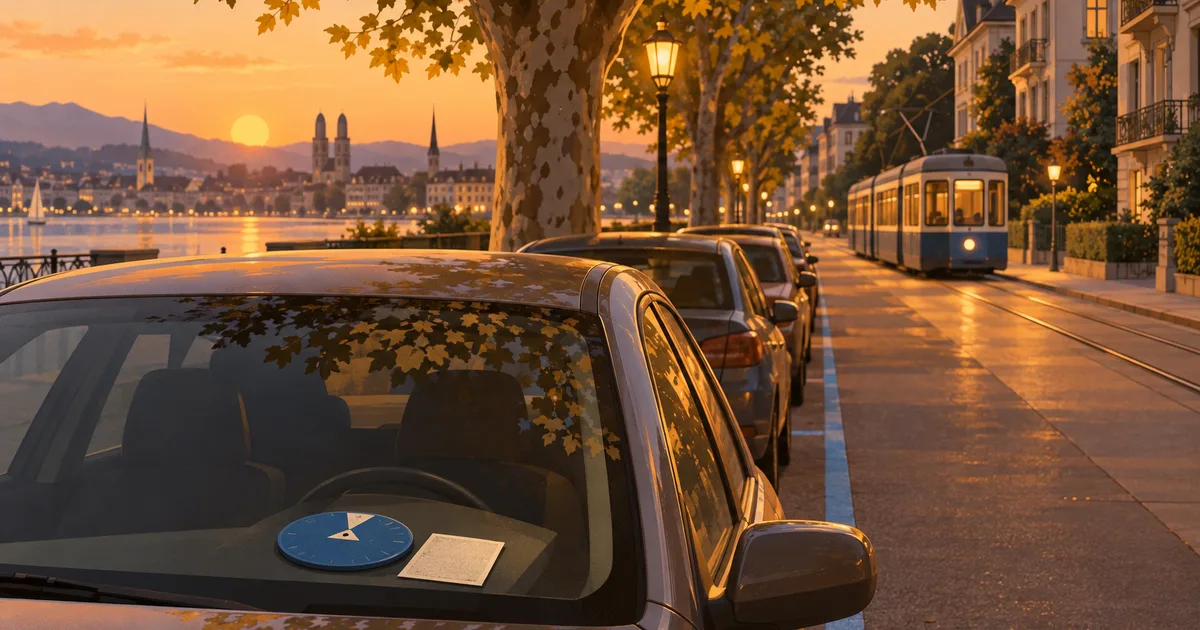
Before you park
If you live in the city of Zurich and your car is registered in your name at your address, you can buy a resident parking permit for the blue zone of your postcode district. In 2026 it costs CHF 300 a year. From 1 January 2027 the city plans a stricter version: no permit if you can use a private space at your address, and a price set by your car's weight.
So the permit is cheap, but it is no promise of a space, and the rules change on 1 January 2027. This guide covers what you need to qualify today, what the 2027 rules will ask, what a garage space really costs and how far you get without a car. Each figure links to the office or company that published it.
Who can get a resident parking permit in Zurich?
Today the test is simple: you live in the city, and the car is yours. The city's resident permit page says the permit lets you leave light motor vehicles in the blue zone of your postcode district for as long as you like, for CHF 300 per calendar year. Under the current ordinance, registered residents get one permit for each light motor vehicle registered in their name at their address in that zone. Local businesses can get one too.
The car's papers decide more than most newcomers expect. If the car is registered to your employer or to someone else, it does not count as yours, and the newcomers' leaflet of the city's traffic department is blunt about it: you are only entitled to a permit for vehicles where you are the registered keeper. The same leaflet sets the clock. When you register at the residents' office (Personenmeldeamt), you can buy a provisional permit valid for 45 days. Within 14 days of moving you must change the address in your vehicle papers at the road traffic office (Strassenverkehrsamt). If you meet that deadline, the bill for the definitive permit usually arrives by itself.
How you apply depends on your plates. With Zurich plates you can order online, by phone or in writing. Weekly residents (people who keep their main home elsewhere) and drivers with plates from another canton or another country must apply in writing, with a copy of the vehicle registration document. The online shop checks your order against the residents' register and the cantonal vehicle register, so an order fails if your car papers still show the old address. The permit office cannot correct those records for you: fix the address at the road traffic office first. For anything the shop cannot handle, the permit office at Mühlegasse 18 is open Monday to Friday from 7:30 to 16:00.
Once you hold the card, it helps to know exactly what it does and does not buy.
Where the permit lets you park
The permit covers the blue zone of the postcode district printed on it, and nothing more. You may park without a time limit only where an extra plate on the blue-zone sign says so («Mit Parkkarte … unbeschränkt»). White spaces, which you pay at a meter or by app, are not included, and the city states plainly that buying a permit gives you no right to a space. In the city centre, postcode 8001, the city's day permit page says no blue-zone spaces are available there.
Without a permit, the blue zone works with a parking disc. From Monday to Saturday, between 8:00 and 11:30 and between 13:30 and 18:00, you may park for one hour, according to the city's parking disc rules. Arrive between 11:30 and 13:30 and you may stay until 14:30. Electronic discs are not allowed, and you set the disc to the next half hour after you arrive: arrive at 9:05, set it to 9:30, leave by 10:30.
For visitors, or for a day when you need your car near home, there is the day permit. It costs CHF 15, or CHF 150 for a block of ten, and lets one light vehicle park for a whole calendar day in every blue zone of the city. You fill in the date and plate yourself, unused permits are not refunded, and blocks are sold only at the permit office and at city police stations.
Residents who share one car can each get a permit for it. The group applies in writing, with copies of the vehicle registration and every member's driving licence, no member may keep a second light vehicle, and each card is valid only in the postcode districts printed on it. That still leaves the main question for anyone who drives: whether there is a space.
More permits than spaces
In 2022 the city issued roughly one resident permit for every blue-zone space, and the spaces have kept shrinking since. In its report to the city parliament of July 2023, the City Council counted 32,154 resident permits for private persons and firms in 2022, and about 32,000 blue-zone spaces at the end of that year. The same report counted about 220,000 private parking spaces in the city, almost seven for every blue-zone space.
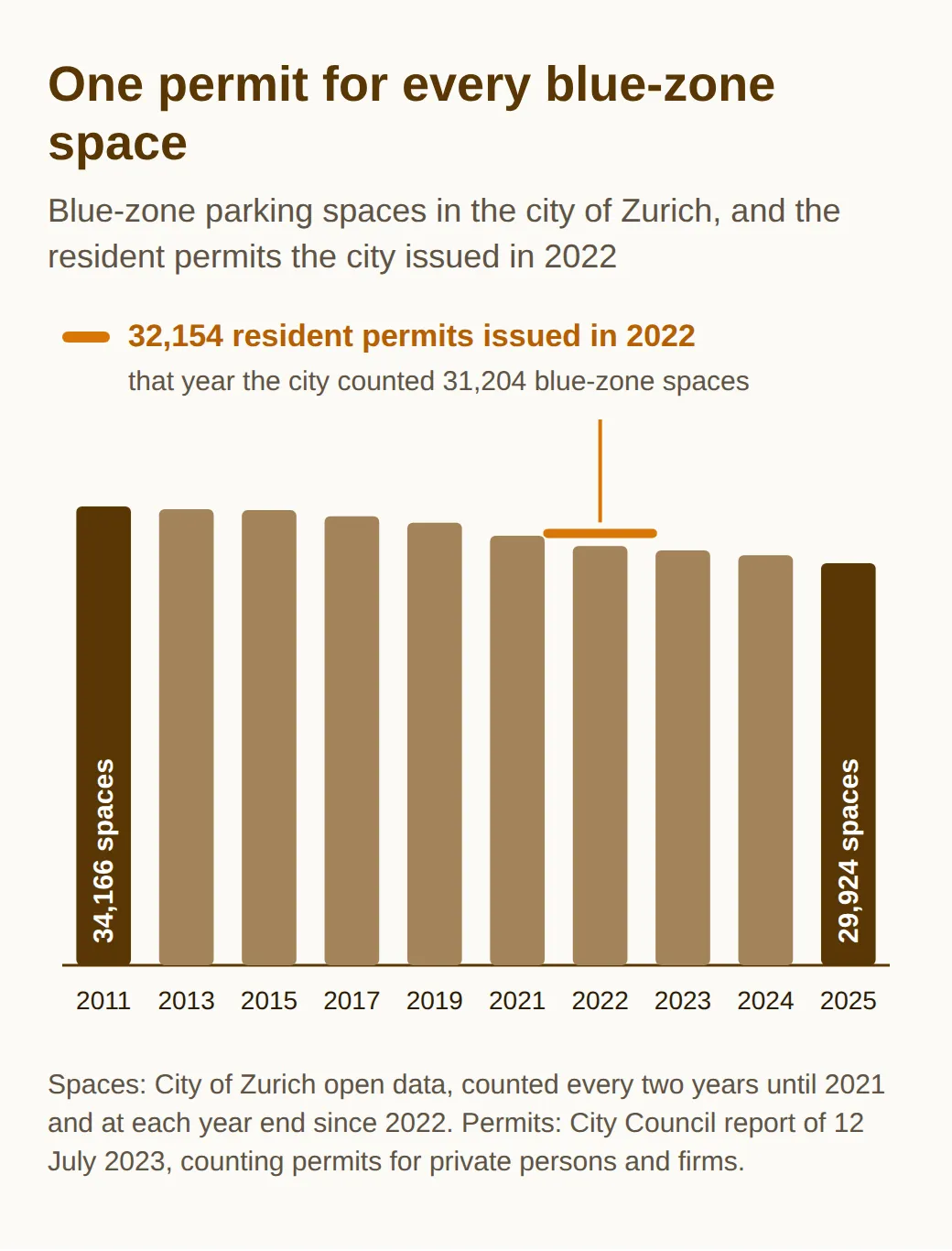
The city's open data, recounted with a revised method in 2026, shows the fall: 34,166 blue-zone spaces in 2011, 31,204 at the end of 2022 and 29,924 at the end of 2025. That is no accident. The city's binding transport plan, quoted in the same report, says blue-zone spaces should be reduced and handed over to trees, cycle lanes, pavements and loading bays, and that residents should get one only if they cannot park privately at home.
That last sentence is the core of the new rules.
What changes on 1 January 2027
From 2027 a resident permit is meant to depend on whether you can park privately at home. The new parking permit ordinance (Parkkartenverordnung) was passed by the city parliament on 20 November 2024 and approved by voters on 28 September 2025, by 63,763 votes to 56,948. Under its Article 17, residents get a permit only if they cannot use a private parking space at their registered address and say so in a truthful self-declaration. Buildings approved as car-low developments, which are built with fewer spaces on purpose, get no permits at all. Each resident gets one permit, no longer one per car.
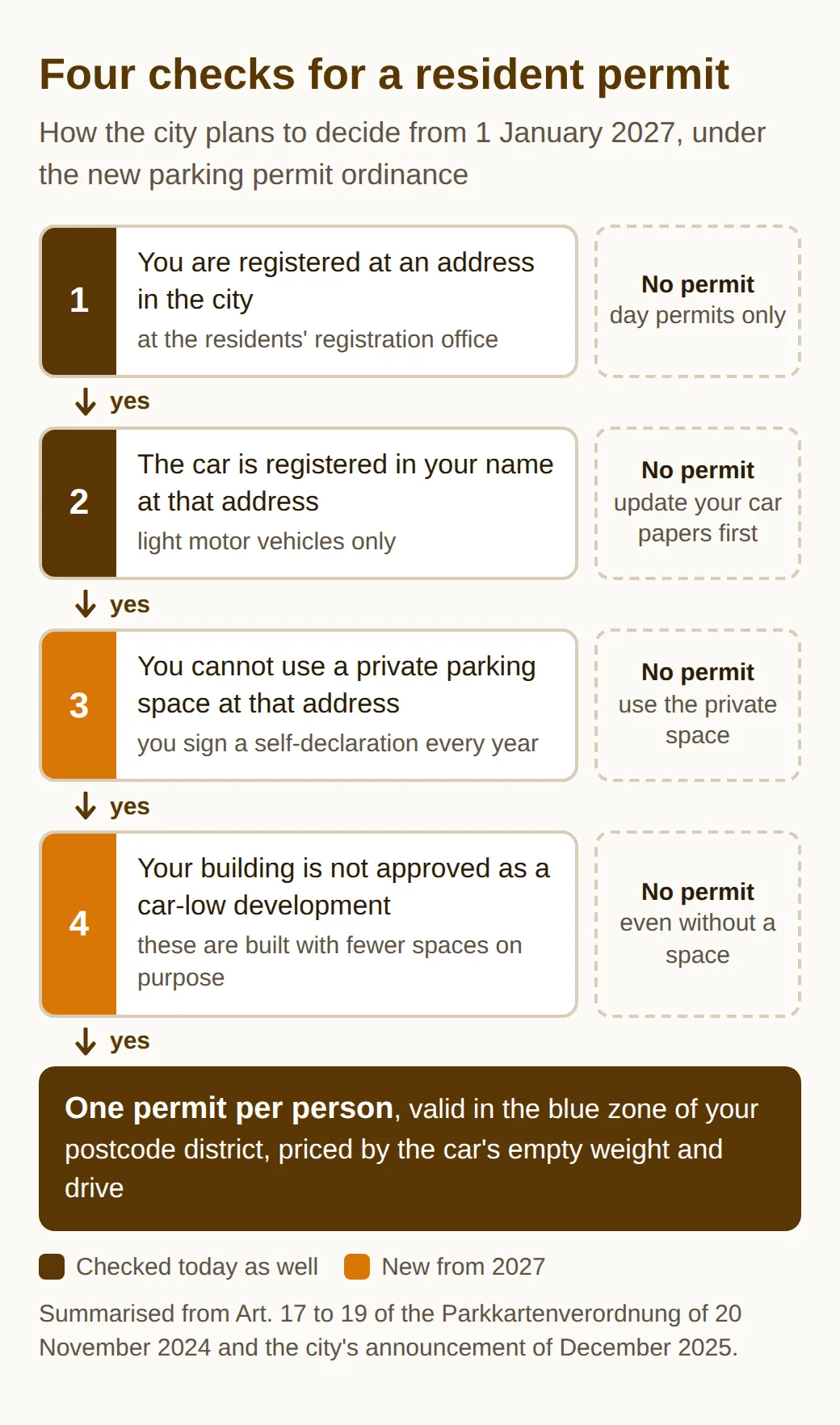
The City Council's report explains how the check will run. You confirm the self-declaration each time you buy or renew, which means every year. The city checks a sample of declarations and may ask landlords to confirm them. The practice is known in Switzerland as the Biel model (Bieler Modell).
The timing comes from the city itself. In its December 2025 announcement, it said the uncontested parts of the ordinance would come into force in steps, with the resident permit under the Biel model from 1 January 2027. The appeals against the ordinance concern a different question. In two rulings of 24 and 25 August 2026, the district council (Bezirksrat) struck down the clauses that let tradespeople, sales reps, doctors, home-care staff and some public services park on pavements and in no-parking zones, and on 23 September 2026 the city parliament voted to appeal to the cantonal administrative court. The resident permit rules were not part of that case. The city's permit page still lists the flat CHF 300, so check it again before you renew for 2027.
How much will the permit cost from 2027?
The new fee follows your car's empty weight and its drive. The ordinance's annex sets a range of 35 to 45 centimes per kilogram a year for a car with a fossil-fuel drive, and 30 to 40 centimes for an emission-free one. The City Council picks the exact rate inside that range. If several vehicles share one plate, the heaviest counts. We could not find the final rate published on the city's pages, so the chart shows what the ranges mean for five example weights.
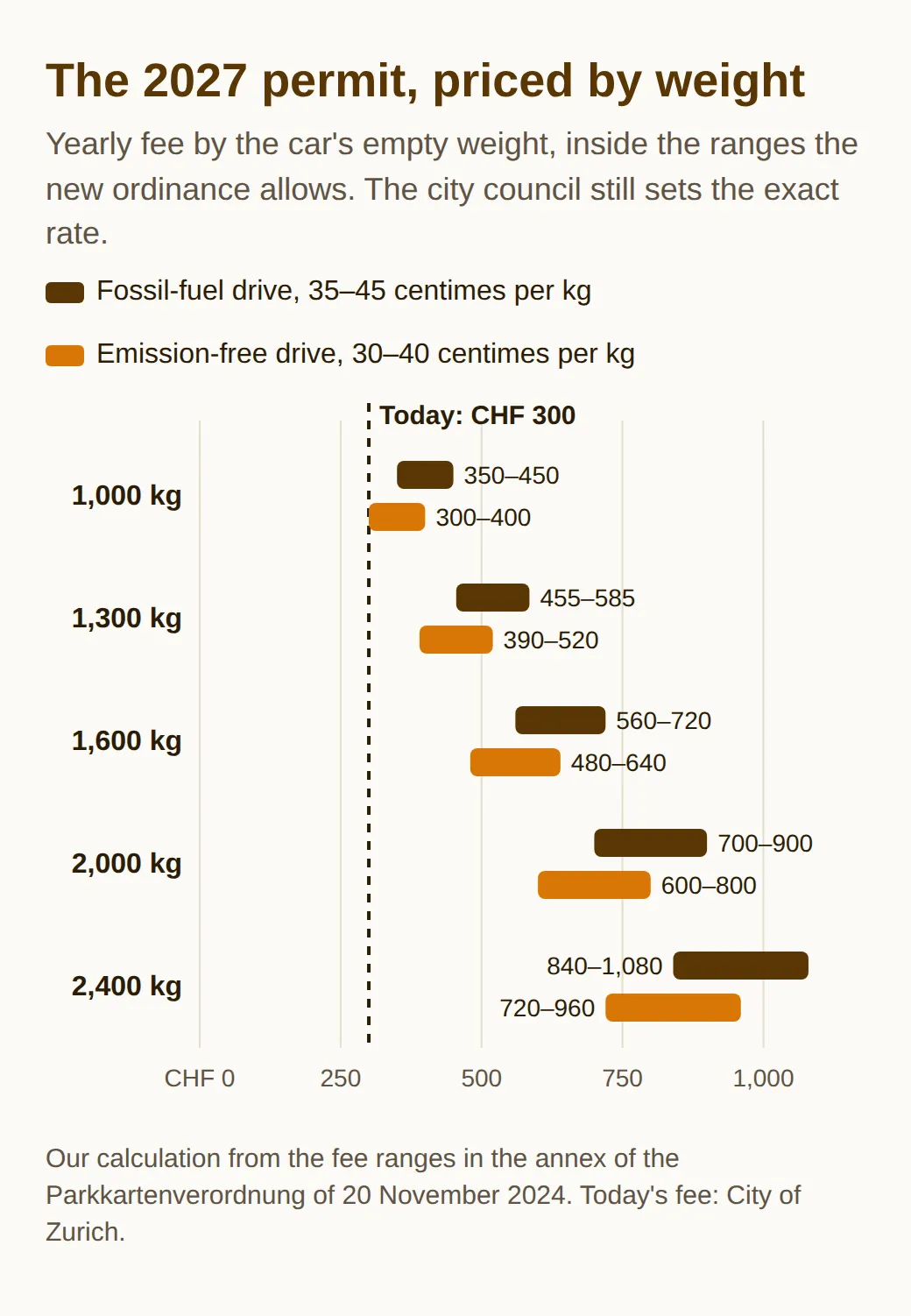
At the bottom of the range, a one-tonne electric car pays exactly today's CHF 300; a heavier car or a higher rate means more. A 1,600 kg car with a petrol engine lands between CHF 560 and 720 a year, about 1.9 to 2.4 times the current price. The City Council had first proposed a flat CHF 540, according to its 2023 report; the city parliament replaced that with the weight scale.
For most cars, the price goes up. For many renters, though, the bigger question is whether they qualify at all.
What "a private space you can use" means for renters
The rule is clear on paper and open in practice. The ordinance speaks of a private parking space you can use at your registered address. It does not say, and we found no city guidance yet that says, how the city will treat a building whose garage has spaces you could rent but don't. Until the city publishes its forms and practice, plan for the strict reading: if your building has a garage with a free space, expect to be asked why you are not using it.
That makes a few questions worth asking before you sign a lease, ideally by email so you keep the answer:
Does the building have a garage or outdoor parking spaces? Is a space included with this flat, or offered separately, and at what monthly rent? Are any spaces free at the moment? Is the building approved as a car-low development?
How the space is let matters too. Under the Code of Obligations, the rules for renting a home also cover things the landlord lets together with it, so a space that belongs to your flat's lease shares that lease's protection and notice periods. A space let on its own contract is different: Article 266e lets either side end it with two weeks' notice to the end of a one-month period, unless the contract sets a longer one. That suits you if you might not need it for long. It also means the landlord can take it back almost as quickly. Our guide to tenant rights in Zurich covers your lease itself in more detail.
If you end up renting a space, it helps to know what one costs.
How much does a garage space cost in Zurich?
A fixed space in a city-owned garage costs between about CHF 150 and 540 a month. The city lets 1,600 of the 3,400 spaces in its ten public garages on monthly contracts, and it publishes the prices for a fixed space, VAT included:
| Garage | Area | Fixed space per month |
|---|---|---|
| Hardau II | Albisriederplatz | CHF 148–180 |
| Dorflinde | Oerlikon | CHF 170.80 |
| Feldegg | Seefeld | CHF 216.20–356.75, by size |
| Vorderberg | Fluntern | CHF 241.10 |
| Zürichhorn | Seefeld | CHF 243.25 |
| Helvetiaplatz | Langstrasse area | CHF 324.30 |
| Hohe Promenade | Old town, Stadelhofen | CHF 432.40 |
| Urania | City centre | CHF 540.50 |
The minimum rental is two months and the notice period one month. The other option is the 7/24 pass, from CHF 151.35 a month at Hardturm. It comes without a fixed space: you take whatever space is free, and when the garage is full you have no right to get in.
Outside the city's garages, spaces are let by private owners and property managers, and the published city prices give you a benchmark when you compare an offer. Against today's permit, which works out at CHF 25 a month, a city garage space costs about six to more than twenty times as much. Against the 2027 fee for a heavy car, the gap narrows, and a covered space you can count on starts to look different.
That comparison is the point where many people in Zurich ask whether they need the car at all.
Living in Zurich without a car
In the city of Zurich, households without a car have been in the majority for several years, according to the canton's travel survey. Here is what the alternatives cost. Inside the city, zone 110, you need a ZVV pass for 1–2 zones, and a personal one costs CHF 88 a month or CHF 813 a year in second class. From 13 December 2026 the new fares are CHF 91 a month and CHF 840 a year.
A cheaper pass is planned, but not soon. City voters approved a CHF 365 annual pass for zone 110 on 28 September 2025. In September 2026 the City Council sent its plan to the city parliament: a discount on existing annual passes for people whose main home is in the city. It costs so much that voters must approve it again, and the city says the pass could start in spring 2028 at the earliest.
For the trips a tram can't do, car sharing covers a lot. Mobility's mobilityPLUS plan costs CHF 9.90 a month after a CHF 39.90 activation fee, with the first three months free and no monthly fee under 28, and trips from CHF 2.00 an hour plus CHF 0.60 per kilometre.
Where you live changes the sum more than anything else. A flat near an S-Bahn station makes it easier to do without a car, and our guide to the best districts in Zurich shows how the neighbourhoods differ.
What to do before you sign a lease
Decide about the car before you choose the flat, not after. If you keep it, check the postcode of each flat you view, ask the parking questions above in writing, and count the space's rent into your budget next to the flat's. From 2027, a building with a garage may leave you without a permit, while a building with no parking at all may leave you hunting for a blue-zone space every evening.
When you move in, do the paperwork in the right order. Register at the residents' office and buy the provisional permit there, change the address in your vehicle papers within 14 days, then order the definitive permit. If your car has plates from abroad or another canton, send the written application in the first week, because the 45 days of the provisional permit pass quickly. For the search itself, our guide to finding an apartment in Zurich walks you through the application file and the viewings.
Common questions
Can I park overnight in the blue zone without a permit?
Usually, yes. On weekdays and Saturdays, a car that arrives after 6 pm with its parking disc set may stay until 9 am the next morning, and between 7 pm and 7:59 am you need no disc at all if you leave before 8. On Sundays and public holidays there is no time limit unless a sign says otherwise.
Do I get money back if I move away or sell the car?
Yes, for every full month you no longer use. You have to report the change within 14 days and send the original card back to the permit office, ideally by registered post. The refund is paid to a bank or postal account, and it depends on the date the card arrives.
What happens to my permit when I move within Zurich?
It is only valid for your old postcode district. Register the move, change the address in your vehicle papers within 14 days, and either swap the card at the counter at Mühlegasse 18 or send it back marked for exchange. A provisional permit for the new district covers you for up to 45 days.
Can I get a permit as a weekly resident or with foreign plates?
You can apply, but not online or by phone. Weekly residents and drivers with plates from another canton or another country must send a written application with a copy of the vehicle registration document. The other conditions stay the same, so the car still has to be registered in your name.
More from the blog
All posts
Internet provider for your Zurich apartment: 2026 checklist
Before you choose an internet provider for a Zurich apartment: check fibre and cable at the address, find the socket ID, know the notice rules, order in time.

Quiet apartment in Zurich? Check the noise maps first
Is that Zurich flat quiet? Read the city's noise map spot by spot, the airport's runway hours and the legal limits, and know your rights if it gets louder.

Buy or rent in Zurich? The 2026 numbers for one flat
Buy or rent in Zurich in 2026: city prices against rents, the equity and one-third income rules, the 2029 end of imputed rent tax and one flat worked through.